
bloc.reactors#
Custom Cantera reactor extensions and solvers.
Submodules#
- bloc.reactors.base
- bloc.reactors.builders
- bloc.reactors.cgr_net
- bloc.reactors.cgr_validation
- bloc.reactors.energy_stream
- bloc.reactors.march_engine
- bloc.reactors.models
- bloc.reactors.optim
- bloc.reactors.pfr_networks
- bloc.reactors.plug_flow
- bloc.reactors.sizing
- bloc.reactors.solvers
- bloc.reactors.stirred
- bloc.reactors.torch_mixing
- bloc.reactors.tube_furnace
Attributes#
Classes#
Design-oriented constant-pressure mole reactor with helper APIs. |
|
Placeholder reactor for the CGR composite unit operation. |
|
Composite stage network for the CGR unit operation. |
|
Mixin giving a reactor discoverable |
|
A single energy flow attached to a reactor. |
|
PBR 100 — arc-heated plasma source (instantaneous-heating variant). |
|
Stage network driving a |
|
ReactorNet subclass implementing Forward-Backward Sweep for a PFR stage. |
|
Single-pass PFR network for the thin-shell hypothesis. |
|
Industrial quartz-tube / lab-tube reactor. |
|
Industrial Carbon Growth Reactor (CGR) / refractory-lined vessel. |
|
Plug Flow Reactor (PFR) engine — closed Lagrangian parcel march. |
|
PFR engine with a prescribed GAS temperature profile T_gas(x). |
|
PFR engine with homogeneous-shell radial heat loss. |
|
Unified network driver for any |
|
PFR engine with thin-shell local-temperature radial heat loss. |
|
PFR engine with a prescribed wall-temperature profile. |
|
Perfectly Stirred Reactor (PSR) engine — well-mixed, constant-pressure. |
|
IdealGasConstPressureReactor with additional features for carbon quality calculations. |
|
IdealGasMoleReactor with additional features for carbon quality calculations. |
|
IdealGasReactor with additional features for carbon quality calculations. |
|
Industrial Torch Mixing Reactor (TMR) / multi-inlet well-mixed vessel. |
|
Engine: instantaneous HP mix of two inlet streams + closed-τ chemistry. |
|
ReactorNet subclass for instantaneous-mix + closed-τ chemistry. |
|
Industrial model: instantaneous mix + closed chemical residence time. |
|
Industrial model: quench a hot stream to a target outlet temperature. |
|
Industrial Plasma Torch model — instantaneous-heating variant. |
|
Torch physics engine with instantaneous enthalpy jump (plasma / simplified). |
|
ReactorNet subclass implementing torch adiabatic integration. |
|
Stage network driving a |
|
Tube furnace with soot-augmented grey-gas radiation. |
|
Industrial Tube Furnace model. |
Functions#
|
Radiative flux from a participating gas to the tube wall in W/m2. |
|
Natural convection coefficient at the external wall of a horizontal cylinder. |
|
Natural convection coefficient at the external wall of a vertical cylinder. |
|
Solve heat transfer through a series thermal resistance stack. |
|
Linearized radiative conductance for small temperature differences. |
|
Compute the internal forced-convection coefficient h = Nu k / D in a tube. |
|
Thermal resistance of a conducto-convective heat transfer surface. |
|
Thermal resistance for radial conduction in cylindrical geometry. |
|
Return the temperature in °C for a given enthalpy in J/kg and for a given gas composition and pressure. |
|
Switch the mechanism of a gas object. |
|
Return the mass fraction of solid carbon species in the gas object. |
|
Return the |
|
Build a fresh CLOSED carrier reactor (no flow devices) and a bare ReactorNet. |
|
Copy outlet TPX from src_phase back onto the stage dst_reactor. |
|
Single forward pass of a CLOSED Lagrangian parcel from inlet to outlet. |
|
Find the mass flow rate (in kg/s) of the second injection to reach the desired temperature in the reactor. |
|
Find the mass flow rate (in kg/s) of the 2nd injection to reach the desired temperature at the reactor entrance. |
|
Find the mass flow rate (in kg/s) of the second injection to reach the desired specific enthalpy at the reactor output. |
|
Find the mass flow rate (in kg/s) of the second injection to reach the desired specific enthalpy |
|
Compute the required quench mass flow for a desired mixed outlet temperature. |
|
Return True when kind is a registered STONE kind for any PFR/CGR profile reactor. |
|
Serialize a closed CSTR residence-time profile for the Plots tab. |
|
Serialize a spatial |
|
|
|
qm_in = v * S_in * density <=> v = qm_in / (S_in*density). |
|
Compute the power recovered from the preheating of the torch and the second injection. |
|
Compute residual heat after recovery in the exchanger. |
|
Compute carbon yield (solid C mass / total C mass in feed). |
|
Compute the H2 yield of the process from the states object. |
|
Compute the mass of the reactor based on its dimensions and the insulation layers. |
|
Mix two gas streams adiabatically at constant pressure. |
|
Solve the kinetics in an adiabatic isobaric reactor at P_bar (bar) for a residence time t_res (s). |
|
Solve kinetics in a PFR with a prescribed temperature profile T(x). |
|
Solve kinetics in a PFR with a prescribed specific-enthalpy profile h(t). |
|
Solve kinetics in a PFR heated by a temperature-difference-driven flux. |
|
Solve kinetics in a PFR with a prescribed temperature profile T(t). |
|
Solve the kinetics in an isothermal isobaric reactor at T_reactor_C (°C) and P_bar (bar) for a residence time t_res (s). |
|
Return True when kind is a registered STONE kind for any PSR-family mixer. |
|
Specific Energy Input [MJ/kg] = electrical input per kg of feed. |
|
Specific Energy Output [MJ/kg] = thermal power to gas per kg of feed. |
|
Return True when kind is a registered STONE kind for any torch. |
Compute tube-furnace engineering KPIs from a solved STONE Simulation. |
Package Contents#
- bloc.reactors.Pr_air_20C = 0.707#
- bloc.reactors.alpha_air_20C = 2.25e-05#
- bloc.reactors.compute_gas2wall_radiative_flux(T_g, T_w, kappa_grey, D)#
Radiative flux from a participating gas to the tube wall in W/m2.
Uses the grey gas approximation with cylindrical geometry (mean beam length approximation via spherical integral).
Assumptions:
Temperature and composition are uniform in the cross-section.
Grey body gas with absorption coefficient
kappa_grey.Walls are black (covered by soot); no wall reflection.
\[ \begin{align}\begin{aligned}f_{\mathrm{trans}} = 2 \int_0^{\pi/2} e^{-\kappa D \cos\theta} \cos^2\theta \sin\theta \, d\theta\\q_{\mathrm{rad}} = \left(\frac{2}{3} - f_{\mathrm{trans}}\right) \sigma_{\mathrm{SB}} (T_g^4 - T_w^4)\end{aligned}\end{align} \]Positive
q_radmeans net heat transfer from gas to wall.- Parameters:
T_g (
float) – Gas temperature in K.T_w (
float) – Wall temperature in K.kappa_grey (
float) – Grey gas absorption coefficient in 1/m. Usekappa_grey = 0to disable gas radiation.D (
float) – Tube inner diameter in m.
- Returns:
q_rad (
float) – Net radiative heat flux from gas to wall in W/m2.f_trans (
float) – Transmittance factor (dimensionless).
- bloc.reactors.compute_hCC_natConv_horizCyl(diameter, length, T_wall_C, T_amb_C, conductivity=conductivity_air_20C, nu=nu_air_20C, alpha=alpha_air_20C, Pr=Pr_air_20C)#
Natural convection coefficient at the external wall of a horizontal cylinder.
Uses Churchill & Chu (1975) correlation.
\[ \begin{align}\begin{aligned}\mathrm{Ra}_D = \frac{g \beta (T_{\mathrm{wall}} - T_{\mathrm{amb}}) D^3}{\nu \alpha}\\\mathrm{Nu}_D = \left(0.6 + \frac{0.387 \mathrm{Ra}_D^{1/6}} {(1 + (0.559/\mathrm{Pr})^{9/16})^{8/27}}\right)^2, \quad h = \frac{\mathrm{Nu}_D \, k}{D}\end{aligned}\end{align} \]- Parameters:
diameter (
float) – Outer diameter in m.length (
float) – Cylinder length in m (unused in this correlation, kept for API consistency).T_wall_C (
float) – Wall temperature in deg C.T_amb_C (
float) – Ambient temperature in deg C.conductivity (
float, optional) – Fluid thermal conductivity in W/m/K. Defaults to air at 20 deg C.nu (
float, optional) – Kinematic viscosity in m2/s. Defaults to air at 20 deg C.alpha (
float, optional) – Thermal diffusivity in m2/s. Defaults to air at 20 deg C.Pr (
float, optional) – Prandtl number. Defaults to air at 20 deg C.
- Returns:
Convective heat transfer coefficient h in W/m2/K.
- Return type:
float
- bloc.reactors.compute_hCC_natConv_vertCyl(diameter, length, T_wall_C, T_amb_C, conductivity=conductivity_air_20C, nu=nu_air_20C, alpha=alpha_air_20C, Pr=Pr_air_20C)#
Natural convection coefficient at the external wall of a vertical cylinder.
Correlation from Taine / Lefevre (1956).
Warning
Valid for laminar flow only; gives low h values.
\[ \begin{align}\begin{aligned}\mathrm{Ra}_L = \frac{g \beta (T_{\mathrm{wall}} - T_{\mathrm{amb}}) L^3}{\nu \alpha}\\\mathrm{Nu} = \frac{4}{3} \left(\frac{7 \mathrm{Ra}_L \mathrm{Pr}}{100 + 105 \mathrm{Pr}}\right)^{1/4} + 0.1143 \frac{272 + 315 \mathrm{Pr}}{64 + 63 \mathrm{Pr}} \frac{L}{D}, \quad h = \frac{\mathrm{Nu} \, k}{L}\end{aligned}\end{align} \]- Parameters:
diameter (
float) – Outer diameter in m.length (
float) – Cylinder length in m.T_wall_C (
float) – Wall temperature in deg C.T_amb_C (
float) – Ambient temperature in deg C.conductivity (
float, optional) – Fluid thermal conductivity in W/m/K. Defaults to air at 20 deg C.nu (
float, optional) – Kinematic viscosity in m2/s. Defaults to air at 20 deg C.alpha (
float, optional) – Thermal diffusivity in m2/s. Defaults to air at 20 deg C.Pr (
float, optional) – Prandtl number. Defaults to air at 20 deg C.
- Returns:
Convective heat transfer coefficient h in W/m2/K.
- Return type:
float
- bloc.reactors.compute_heat_losses_linear(Tr_C, Tamb_C, R_list)#
Solve heat transfer through a series thermal resistance stack.
\[R_{\mathrm{tot}} = \sum_i R_i, \quad \Phi = \frac{T_{\mathrm{reac}} - T_{\mathrm{amb}}}{R_{\mathrm{tot}}}, \quad \Delta T_i = \Phi \, R_i\]- Parameters:
Tr_C (
float) – Temperature inside the reactor in deg C.Tamb_C (
float) – Ambient temperature in deg C.R_list (
listoffloat) – Thermal resistances in K/W, ordered from reactor interior to ambient.
- Returns:
{"Phi": float, "T_reac": float, "T_wall_ext": float, "T_amb": float, ...}wherePhiis heat loss in W.- Return type:
dict
- bloc.reactors.compute_hrad_linearRadiation(eps, Tmoy)#
Linearized radiative conductance for small temperature differences.
\[h_{\mathrm{rad}} = \varepsilon \sigma_{\mathrm{SB}} \, 4 T_{\mathrm{moy}}^3\]- Parameters:
eps (
float) – Emissivity, dimensionless.Tmoy (
float) – Mean temperature in K.
- Returns:
Linearized radiative heat transfer coefficient in W/m2/K.
- Return type:
float
- bloc.reactors.conductivity_air_20C = 0.0263#
- bloc.reactors.internal_convection_h(diameter, mass_flow_rate, gas, x_position=None)#
Compute the internal forced-convection coefficient h = Nu k / D in a tube.
Transport properties (viscosity, thermal conductivity, heat capacity) are read from the Cantera
Solutionat its current state; the mechanism must define a transport model. The Nusselt number comes frominternal_nusselt(), which is continuous in Re across the laminar, transition and turbulent regimes – this function is evaluated inside the march’s ODE right-hand side, where a step in h is a discontinuity the integrator’s Newton solver cannot converge across.- Parameters:
diameter (
float) – Tube inner diameter in m.mass_flow_rate (
float) – Mass flow rate through the tube in kg/s.gas (
cantera.Solution) – Gas object at the current thermodynamic state (must have transport).x_position (
floatorNone, optional) – Distance from the tube inlet in m; entry-length correlations apply when given, fully developed flow otherwise.
- Returns:
Convective heat transfer coefficient h in W/m2/K.
- Return type:
float- Raises:
ValueError – If
gas.transport_model == 'none'.
Notes
For CH4 pyrolysis conditions (10 SLM, D = 100 mm), Re ~ 130–250 across 25–1600 degC, so the flow is laminar throughout; radiation dominates at high temperature.
- bloc.reactors.nu_air_20C = 1.589e-05#
- bloc.reactors.sigma_SB = 5.67e-08#
- bloc.reactors.thermal_resistance_CC(h_CC, S)#
Thermal resistance of a conducto-convective heat transfer surface.
\[R = \frac{1}{h_{\mathrm{CC}} \, S}\]- Parameters:
h_CC (
float) – Heat transfer coefficient in W/m2/K.S (
float) – Surface area in m2.
- Returns:
Thermal resistance in K/W.
- Return type:
float
- bloc.reactors.thermal_resistance_radial_conduction(diameter, length, conductivity, e_insulation)#
Thermal resistance for radial conduction in cylindrical geometry.
\[R = \frac{\ln(r_2/r_1)}{2\pi k L}, \quad r_1 = D/2, \quad r_2 = D/2 + e_{\mathrm{insulation}}\]- Parameters:
diameter (
float) – Inner diameter in m.length (
float) – Cylinder length in m.conductivity (
float) – Thermal conductivity of insulation in W/m/K.e_insulation (
float) – Insulation thickness in m.
- Returns:
Thermal resistance in K/W.
- Return type:
float
- bloc.reactors.find_temperature_from_enthalpy(h_mass, X, P_bar, mechanism)#
Return the temperature in °C for a given enthalpy in J/kg and for a given gas composition and pressure.
- Parameters:
h_mass (-) – Specific enthalpy target in J/kg
X (-) – Composition of the gas in mole fraction
P_bar (-) – Pressure in bar
mechanism (-) – Path to the mechanism file
- bloc.reactors.switch_mechanism(gas, new_mechanism, htol=0.0001, Xtol=0.0001, verbose=False)#
Switch the mechanism of a gas object.
Useful to switch from plasma to reactor simulation for instance. As some species may not be present in the new mechanism, we compute the adjust the temperature of the new gas object to match the enthalpy of the old gas object, so that energy is conserved. Still, if the chemical enthalpy variation exceed htol, an error is raised. Similarly, if the mole fraction variation exceed Xtol, a error is raised.
- Parameters:
gas (
ct.Solution) – Gas objectnew_mechanism (
str) – Path to the new mechanism filehtol (
float) – Tolerance for the chemical enthalpy variation between the two mechanisms. Default is 1e-4.Xtol (
float) – Tolerance for the mole fraction variation between the two mechanisms. Default is 1e-4.verbose (
bool) – If True, print information about the process. Default is False.
- Returns:
gas_new – Gas object with the new mechanism
- Return type:
ct.Solution
- bloc.reactors.get_solid_carbon_mass_fraction(gas, solid_sp=['C(s)', 'C(soot)', 'CSOLID'], n_C_min=300)#
Return the mass fraction of solid carbon species in the gas object.
Solid species are identified by their name or by the number of carbon atoms, through
get_solid_carbon_species().- Parameters:
gas (
cantera.Solution) – The gas object containing gaseous species and soot.solid_sp (
listofstr, optional) – List of solid species to consider. Default is [“C(s)”, “C(soot)”, “CSOLID”].n_C_min (
int, optional) – Minimum number of carbon atoms to consider a species as solid. Default is 300. This is used as a second filter to identify solid carbon species. A specie is considered solid if it satisfies one criterium (s in solid_sp) OR the other (n_C >= n_C_min).
- Returns:
The mass fraction of solid carbon species in the gas object.
- Return type:
float
- class bloc.reactors.DesignIdealGasConstPressureMoleReactor(gas, *args, **kwargs)#
Bases:
cantera.ExtensibleIdealGasConstPressureMoleReactorDesign-oriented constant-pressure mole reactor with helper APIs.
Inherits from
ExtensibleIdealGasConstPressureMoleReactorso that subclasses can intercept Cantera’s ODE callbacks without modifying C++ code.The key hook used here is
before_update_state(): CVODE callsupdateState(y)before its very firsteval, at which pointyis still writable. By storing a pending initial condition in_pending_initand writing it intoyon the first call, any subclass can override CVODE’s starting point — even thoughm_state(the C++ snapshot taken at construction) cannot be changed from Python.- Parameters:
gas – Cantera
Solutionobject used to initialise the reactor.
- before_update_state(y)#
Inject a pending initial state into CVODE’s y before the first eval.
Cantera’s
Reactor::initialize()restoresm_state(the state snapshot taken at construction time) via a direct C++ call that bypasses all Python delegates. The only reliable interception point is here: CVODE callsupdateState(y)just before its firsteval, andyis writable.If
_pending_initis set, this method overwritesywith values derived from the HP-corrected gas state and clears the flag. All subsequentupdateStatecalls (driven by CVODE’s own stepping) are unaffected.
- solve_adiabatic(mdot, power_kW, t_res_s, verbose=False)#
Solve an adiabatic constant-pressure reactor segment.
Uses this reactor as the ODE owner: applies an enthalpy jump from
power_kW / mdotand integrates with a freshtype(self)(gas, clone=False)carrier fort_res_s.
- switch_mechanism(gas, mechanism_path, htol, Xtol)#
Switch the active mechanism while conserving chemical enthalpy.
See
switch_mechanism()for details.
- external_coeffs(D_ext, L_reac, eps_wall, T_wall_hyp_C, T_amb_C)#
Return convective and radiative heat transfer coefficients at the wall.
- heat_losses_linear(T_mean_C, T_amb_C, R_list)#
Compute linearized heat losses across a thermal resistance stack.
- thermal_resistance(d_reac, L_reac, e_insul_list, cond_list, h_tot, S_ext)#
Build a radial-conduction plus external heat transfer resistance list.
- mass_and_power(qm_torch, T_torch_input_C, X_torch, qm_2nd_inj, T_2nd_inj_C, X_2nd_inj, P_bar, T_amb_C, gas)#
Compute preheat recovery and residual heat based on reactor states.
- mass_reactor(L_reac, d_reac, e_insul_list, density_list, verbose=False)#
Estimate reactor mass and volume from geometry and insulation layers.
- class bloc.reactors.ThreeSegmentsReactor#
Bases:
cantera.ReactorPlaceholder reactor for the CGR composite unit operation.
This reactor is the logical outer node that holds the
_outletstream point and the aggregated outlet phase state. All physics are delegated toThreeSegmentsReactorNet; this object carries only bookkeeping metadata.It is not integrated directly by CVODE.
ThreeSegmentsReactorNetinitialises with an empty reactor list (super().__init__([])) and drives the child reactors explicitly.The
NETWORK_CLASSis intentionallyNonebecause the stage-levelnetwork_classfield in the group config takes precedence over per-reactorNETWORK_CLASSattributes.- NETWORK_CLASS = None#
- class bloc.reactors.ThreeSegmentsReactorNet(reactors, meta=None)#
Bases:
cantera.ReactorNetComposite stage network for the CGR unit operation.
Solves a tube → mix → tube → … chain by composing individual
PFRHomogeneousShellNet(FBS) andInstantaneousMixing.solve_premixedcalls. Aggregates spatial profiles, heat loss, and residence time across all segments.Implements the
boulder.stage_network.CustomStageNetworkprotocol so that Boulder’s trajectory collector storesstatesandscalarsrather than re-sampling the internal CSTR chain.- Parameters:
reactors – All Cantera reactor objects that Boulder built for this stage. This includes the placeholder
ThreeSegmentsReactorparent, allRefractoryReactorsegments, and allInstantaneousMixingReactormixers.meta (
dict, optional) – Composite metadata stored on the stage by the unfolder; keys includecgr_id,segments(ordered list of segment ids),mixers(list of{segment_idx, mixer_id}entries),ambient_id.
- advance_to_steady_state()#
Advance to the outlet state (one nominal advance).
- solve_steady()#
Boulder
solve_steadyentry point — delegates to advance.
- advance(time)#
Solve the tube→mix→tube chain and write aggregated results.
Sequence for N segments and M injection points (M = N - 1):
Read the main inlet state from the first segment’s
_inlet_reservoir(bound at post-build time).FBS-solve segment 1.
For each injection point i (after segment i): a. Read injection feed mdot and gas state from the injection
MFC + reservoir (bound at post-build time on the mixer).
HP-mix segment i outlet with injection feed.
FBS-solve segment i+1 from the mixed state.
Write the last segment outlet to the CGR placeholder reactor’s phase so the stream-point reservoir sees the correct outlet.
Collect aggregated
states(concatenated T(x) with offset x) andscalars(summed heat loss, total L, total t_res).
segmentsandmixersordering are read from the placeholderThreeSegmentsReactorreactor’s_metadict, populated at post-build time by_post_build_cgr_net.
- property states: cantera.SolutionArray | None#
Concatenated spatial profile across all segments, built on demand.
- property scalars: Dict[str, Any]#
Aggregated scalar outputs for KPI extraction and Boulder trajectory.
- class bloc.reactors.EnergyPortMixin#
Mixin giving a reactor discoverable
energy_inlets/energy_outlets.Attach records via
add_energy_stream();energy_inletsandenergy_outletsare read-only views over the same list, filtered by the live sign ofEnergyStream.power_w. The backing list is created lazily on first use so no reactor__init__needs editing to pick this up – classes just addEnergyPortMixinto their bases.Most Bloc reactors do not use this mixin; consumers must access it duck-typed, e.g.
getattr(obj, "energy_inlets", []).Example
Declare it as one of the reactor’s bases – no constructor changes needed:
class PFR(EnergyPortMixin, ct.ExtensibleIdealGasConstPressureMoleReactor):
    ...
Once built, whoever owns the reactor attaches its energy stream(s) (typically in a Boulder post-build hook, e.g.
bloc.reactors.builders._post_build_design_volumes()):pfr.add_energy_stream( EnergyStream("loss_wall", kind="heat_loss", wall=loss_wall, wall_sign=wall_sign_for(loss_wall, pfr)) )
From then on,
pfrexposes:energy_inlets/energy_outlets– the live, signed streams currently flowing in/out ([]if none were attached).Discoverability for generic consumers that don’t know about torches or PFRs specifically:
bloc.plotting.sankeyandbloc.boulder_plugins.energy_stream_displayboth walkenergy_inlets/energy_outletson every reactor to draw the “Electricity”/”Heat_loss”-style flows, without any per-reactor-kind branching in that display code (seeis_energy_port_kind()).
- add_energy_stream(stream)#
Attach an
EnergyStreamrecord to this reactor.
- property energy_inlets: list[EnergyStream]#
Energy streams currently flowing into this reactor (power_w > 0).
- property energy_outlets: list[EnergyStream]#
Energy streams currently flowing out of this reactor (power_w < 0).
- class bloc.reactors.EnergyStream#
A single energy flow attached to a reactor.
- Parameters:
name – Identifier for this stream (e.g. the connection id, or a synthetic name for parameter-backed streams).
kind – Open-ended tag describing the physical nature of the flow, e.g.
"electric"(torch power) or"heat_loss"(PFR ambient loss).wall – The real Cantera
Wallbacking this stream, when one exists (e.g. the PFR’s ambient-loss wall).Nonefor pure-parameter streams (e.g. torch power, which never touches Cantera’s solver).wall_sign – Only meaningful when
wallis set. Cantera defineswall.heat_rateas positive when heat flowsleft_reactor -> right_reactor, a convention relative to the Wall itself, not to whichever reactor this stream is attached to. Pass+1.0when the attached reactor iswall.right_reactor(positive heat_rate already means “into this reactor”) or-1.0when it iswall.left_reactor(heat_rate must be negated). Ignored for parameter-backed streams.
- name: str#
- kind: str = 'electric'#
- wall: cantera.Wall | None = None#
- wall_sign: float = 1.0#
- property power_w: float#
Signed power in watts, positive = flowing into the attached reactor.
Wall-backed streams read
wall.heat_ratelive on every access – it is only meaningful post-solve and can change across a staged or iterative solve, so caching a snapshot at construction time would go stale – then applywall_signto reorient Cantera’s left-to-right convention relative to the attached reactor. Parameter-backed streams return the stored scalar (it never changes once computed).
- bloc.reactors.wall_sign_for(wall, reactor)#
Return the
EnergyStream.wall_signfor reactor’s side of wall.Computed from which side reactor is actually on, rather than assumed at each call site – correct regardless of which endpoint a given unfolder happened to declare as the STONE connection’s
source/target.
- bloc.reactors.build_closed_carrier_net(reactor, T, P, X, volume, *, reactor_kwargs=None, use_preconditioner=True, max_steps=None, transport=False)#
Build a fresh CLOSED carrier reactor (no flow devices) and a bare ReactorNet.
Both reactor families share this constructor so the closed-parcel guarantee (“no mass flow in/out during the inner integration”) has a single named home and cannot silently drift between the tube-furnace and PFRHomogeneousShell paths.
The fresh carrier’s phase is a new, independent Solution on the mechanism named by
reactor._mech_source(present on bothPFRWallProfileandDesignIdealGasConstPressureMoleReactor), built throughbloc.io.mechanisms.new_solution()– the file is parsed once per process and the carrier costs a fraction of a second even on a 452-species mechanism – wrapped in a new instance oftype(reactor). Because the carrier is a freshly created object it carries no process flow devices (MFC/PC), so CVODE only sees the closed-system ODEs.transportfits a transport model on the carrier’s phase (seconds on a large mechanism). Only reactor classes that read viscosity or thermal conductivity off their own phase during the march need it (PFRWallProfilefor its internal convection coefficient); the homogeneous-shell family reads none.- Parameters:
reactor – Template reactor whose type and mechanism source are reused.
T – Inlet thermodynamic state (K, Pa, mole fractions).
P – Inlet thermodynamic state (K, Pa, mole fractions).
X – Inlet thermodynamic state (K, Pa, mole fractions).
volume – Initial reactor volume [m³].
reactor_kwargs – Extra keyword arguments passed to
type(reactor)(gas, clone=False, **reactor_kwargs).use_preconditioner – Attach a
cantera.AdaptivePreconditionerto the network.max_steps – If provided, set
net.max_stepson the ReactorNet.
- Returns:
carrier— the fresh closed reactor,gas— thecantera.Solutionused to initialise it,net— the barecantera.ReactorNet.- Return type:
(carrier,gas,net)
- bloc.reactors.copy_state(src_phase, dst_reactor)#
Copy outlet TPX from src_phase back onto the stage dst_reactor.
Called after the inner closed-carrier integration completes so that the original stage reactor (which may carry process flow devices) reflects the converged outlet state. Both
phaseand the reactor’s internal CVODE state vector are updated.
- bloc.reactors.march_lagrangian_parcel(reactor, T_in, P_in, X_in, *, length, diameter, mdot, heat_flux_factory=None, on_position=None, recorder=None, reactor_kwargs=None, n_points=200, max_steps=200000, use_preconditioner=True, rtol=None, atol=None, max_time_step=None, energy_off=False, transport=False, verbose=1)#
Single forward pass of a CLOSED Lagrangian parcel from inlet to outlet.
This is the shared march engine used by both the tube-furnace path (
PFRWallProfileNet) and the PFRHomogeneousShell / PFRThinShell family (_march_pfr_to_length()). It always builds a fresh closed carrier reactor (viabuild_closed_carrier_net()) so the parcel integrates independently of any process flow devices (MFC/PC) that may be attached to the stage reactor. The converged outlet state is copied back to reactor viacopy_state().Integration proceeds in n_points equal spatial checkpoints
x = i * dx,dx = length / n_points. At each checkpoint:on_position(carrier, x_prev)is called (if provided) so the caller can update position-dependent state (e.g.T_wall(x)).The carrier is advanced to the next time point via
net.advance(t + dt)wheredt = dx / vandv = mdot / (rho * S).recorder(carrier, x, net.time)is called (if provided).
A
ct.Wall(ambient, carrier)witharea = 1 m²is built when a heat_flux_factory is provided. The factory receives carrier and must return a callableheat_flux(t) -> float [W/m²](Cantera Wall convention: positive = heat from ambient to carrier).The ambient reservoir uses a throwaway
gri30gas — it is never advanced, so its thermodynamic state is irrelevant.- Parameters:
reactor – Template / stage reactor.
type(reactor)and_mech_sourceare used to build the fresh carrier; the outlet state is copied back here after the march.T_in – Inlet state (K, Pa, mole fractions).
P_in – Inlet state (K, Pa, mole fractions).
X_in – Inlet state (K, Pa, mole fractions).
length – Tube length [m].
diameter – Tube inner diameter [m].
mdot – Mass flow rate [kg/s].
heat_flux_factory –
factory(carrier) -> callablethat builds theWall.heat_fluxfunction. PassNonefor adiabatic.on_position –
on_position(carrier, x)called before each checkpoint advance. Use to setcarrier.T_wall_K,carrier.x_position, etc.recorder –
recorder(carrier, x, t)called after each checkpoint.reactor_kwargs – Forwarded to
build_closed_carrier_net().n_points – Number of spatial checkpoints. Default 200.
max_steps – CVODE maximum steps per checkpoint. Default 200 000.
use_preconditioner – Attach
cantera.AdaptivePreconditioner. Default True.rtol – Relative / absolute CVODE tolerances forwarded to the inner
cantera.ReactorNet.Noneleaves Cantera defaults.atol – Relative / absolute CVODE tolerances forwarded to the inner
cantera.ReactorNet.Noneleaves Cantera defaults.max_time_step – Optional upper bound on the inner CVODE step size [s].
None(default) lets CVODE choose its own internal steps within each spatial-cell advance.energy_off – When True the carrier’s energy equation is disabled (
carrier.energy_enabled = False) so the gas temperature is held constant during each checkpoint advance. The temperature is then a Dirichlet condition imposed by on_position (seePFRGasTemperatureProfile). Default False.transport – Fit a transport model on the carrier’s phase; see
build_closed_carrier_net(). Default False. Also gates theReextra column: when True, the local Reynolds numberRe = mdot * diameter / (S * mu)(same definition asbloc.chem.heat_transfer.internal_convection_h(),muthe Cantera dynamic viscosity) is recorded at every checkpoint; when False,Reisnanthroughout rather than a silently wrong value.
- Returns:
Spatial profile with extra columns
t(residence time [s]),x(axial position [m]) andRe(local Reynolds number [-],nanwhen transport is False – see below). The outlet state is also copied back to reactor.- Return type:
ct.SolutionArray
- class bloc.reactors.PBR100PlasmaTorch(gas, *args, **kwargs)#
Bases:
bloc.reactors.torch_mixing.PlasmaTorchInstantaneousHeatingPBR 100 — arc-heated plasma source (instantaneous-heating variant).
STONE kind:
PBR100PlasmaTorch.Same physics as
PlasmaTorchInstantaneousHeating; adds the PBR 100 nameplate operating envelope (50–100 kW; CH4 5–20 kg/h; H2 20–100 slm; N2 100–350 slm), enforced at build time. SEI/SEO specific-energy metrics are inherited from the base torch class.See also
validate_pbr100_throughput()throughput envelope check.
TorchInstantaneousHeatingSEI_MJ_kg/SEO_MJ_kg.
- NETWORK_CLASS#
- property SEI_MJ_kg: float | None#
Specific Energy Input [MJ/kg] from
_meta(electrical input / feed).Available on every torch once
_post_build_design_volumes()has populatedelectric_power_kWandmass_flow_rateon_meta.
- property SEO_MJ_kg: float | None#
Specific Energy Output [MJ/kg] from
_meta(thermal power to gas / feed).
- solve_adiabatic(mdot, power_kW, t_res_s, verbose=True)#
Solve adiabatic kinetics using this reactor’s current inlet state.
Adds torch power as an enthalpy jump and integrates one adiabatic pass for
t_res_susing a freshtype(self)(gas, clone=False)carrier.
- add_energy_stream(stream)#
Attach an
EnergyStreamrecord to this reactor.
- property energy_inlets: list[EnergyStream]#
Energy streams currently flowing into this reactor (power_w > 0).
- property energy_outlets: list[EnergyStream]#
Energy streams currently flowing out of this reactor (power_w < 0).
- bloc.reactors.find_2nd_inj_mass_flow_rate(gas_torch, qm_torch, gas_2nd_inj, qm_2nd_inj_guess, T_reac_C, verbose=False)#
Find the mass flow rate (in kg/s) of the second injection to reach the desired temperature in the reactor.
This function does not take into account the chemical energy contained in the radicals produced by the torch. Thus, for high enthalpy plasma, the mass flow rate of the second injection will be underestimated.
- Parameters:
gas_torch (-) – Gas object of the torch
qm_torch (-) – Mass flow rate of the torch in kg/s
gas_2nd_inj (-) – Gas object of the reactor input
qm_2nd_inj_guess (-) – Initial guess for the mass flow rate of the second injection in kg/s
T_reac_C (-) – Desired temperature in the reactor in °C
verbose (-) – If True, print verbose output.
- Returns:
- qm_2nd_inj – Mass flow rate of the second injection in kg/s
- Return type:
float
- bloc.reactors.find_2nd_inj_mfr_Tin(gas_torch, qm_torch, gas_2nd_inj, qm_2nd_inj_guess, T_in_target, t_res_PSR, verbose=False)#
Find the mass flow rate (in kg/s) of the 2nd injection to reach the desired temperature at the reactor entrance.
Simulate a PSR for t_res_PSR, and adapt qm_2nd_inj to get T_in_target after t_res_PSR in the PSR.
- Parameters:
gas_torch (-) – Gas object of the torch
qm_torch (-) – Mass flow rate of the torch in kg/s
gas_2nd_inj (-) – Gas object of the reactor input
qm_2nd_inj_guess (-) – Initial guess for the mass flow rate of the second injection in kg/s
T_in_target (-) – Desired temperature at the reactor entrance in °C
t_res_PSR (-) – Residence time in the PSR in s.
verbose (-) – If True, print verbose output.
- Returns:
- qm_2nd_inj – Mass flow rate of the second injection in kg/s
- Return type:
float
- bloc.reactors.find_2nd_inj_mfr_Tout(gas_torch, qm_torch, gas_2nd_inj, qm_2nd_inj_guess, T_out_target, C_solid='C(s)', rescale_factor=1000.0, verbose=False)#
Find the mass flow rate (in kg/s) of the second injection to reach the desired specific enthalpy at the reactor output.
This enthalpy target is defined as the enthalpy of fully converted CH4 at T_out_target. Since the specific enthalpy depends on the initial CH4/H2 ratio, we define hp = ( h - Y_H2*h_H2(T_target) ) / Y_CH4 to remove the dependance of the enthalpy target with the initial CH4/H2 ratio.
Note: this function assumes that only H2 and CH4 are the only species injected in the torch and reactor.
- Parameters:
gas_torch (-) – Gas object of the torch
qm_torch (-) – Mass flow rate of the torch in kg/s
gas_2nd_inj (-) – Gas object of the reactor input
qm_2nd_inj_guess (-) – Initial guess for the mass flow rate of the second injection in kg/s
T_out_target (-) – Desired temperature at the reactor exit in °C
verbose (-) – If True, print verbose output.
- Returns:
- qm_2nd_inj – Mass flow rate of the second injection in kg/s
- Return type:
float
- bloc.reactors.find_2nd_inj_mfr_Tout_generalized(gas_torch, qm_torch, gas_2nd_inj, qm_2nd_inj_guess, T_out_target, rescale_factor=1000.0, verbose=0)#
Find the mass flow rate (in kg/s) of the second injection to reach the desired specific enthalpy at the reactor output.
T_out_target is the target temperature of the reactor output in °C. qm_torch & qm_2nd_inj are in kg/s
- bloc.reactors.find_quench_flow(qm_reac, gas_reac, X_quench, T_quench, T_target, verbose=False)#
Compute the required quench mass flow for a desired mixed outlet temperature.
Assumptions - Ideal-gas enthalpy model (true for Cantera ideal-gas phases): h depends
only on temperature and species; mixture h(T) = sum(Y_k h_k(T)).
Adiabatic, no shaft work, no pressure change during mixing.
- Closed-form solution:
qm_quench = qm_reac * (h1(T1) - h1(Tt)) / (h2(Tt) - h2(T2))
- Parameters:
qm_reac (-) – Mass flow rate of the reactor in kg/s
gas_reac (-) – Gas object of the reactor output
X_quench (-) – Composition of the quench flow in the reactor input
T_quench (-) – Temperature of the quench flow in °C
T_target (-) – Desired temperature after the quench in °C
verbose (-) – If True, print verbose output.
- Returns:
- qm_quench – Mass flow rate of the quench flow in kg/s
- Return type:
float
- class bloc.reactors.PFRGasTemperatureProfileNet(reactors, meta=None, *, T_gas_fn=None, total_length=None, n_points=200, rtol=0.0001, atol=1e-12)#
Bases:
_LagrangianDuckTypedNetMixinStage network driving a
PFRGasTemperatureProfile.Imposes a prescribed gas temperature profile
T_gas(x)on a closed Lagrangian parcel: the energy equation is disabled and the temperature is reset toT_gas(x)at every spatial checkpoint, so only the kinetics evolve. This is the Dirichlet-on-gas counterpart of the wall-drivenPFRWallProfileNet.The public surface is duck-typed to Boulder’s
CustomStageNetwork(time,states,scalars,advance,advance_to_steady_state) and records the axial temperature and species profiles consumed by the calculation note and the plot helpers.- Parameters:
reactors – Iterable containing exactly one
PFRGasTemperatureProfilereactor.meta – Geometry/profile meta dict (populated by
_build_pfr_gas_temperature_profile()). Must containtotal_lengthand the trapezoidal-profile keys (T_gas_K,T_ambient_K,entry_leg,exit_leg,entry_zone,plateau_zone) or an explicitT_gas_profiledict.T_gas_fn – Standalone API: pass an explicit
T_gas(x)callable and tube length instead of the STONE meta dict (used by examples and tests).total_length – Standalone API: pass an explicit
T_gas(x)callable and tube length instead of the STONE meta dict (used by examples and tests).n_points – Standalone API: pass an explicit
T_gas(x)callable and tube length instead of the STONE meta dict (used by examples and tests).rtol – Integrator tolerances forwarded to
march_lagrangian_parcel().atol – Integrator tolerances forwarded to
march_lagrangian_parcel().
- reactors#
- x_arr: numpy.ndarray | None = None#
- t_arr: numpy.ndarray | None = None#
- T_gas_arr: numpy.ndarray | None = None#
- Y_Cs_arr: numpy.ndarray | None = None#
- X_arr: numpy.ndarray | None = None#
- species_names: list | None = None#
- property reactor: bloc.reactors.plug_flow.PFRGasTemperatureProfile#
The single PFRGasTemperatureProfile reactor (used by plot helpers).
- advance_to_steady_state()#
Run the fixed-checkpoint parcel march with the gas temperature imposed.
Idempotent: a second call is a no-op.
- property states: cantera.SolutionArray | None#
Axial Lagrangian profile (satisfies Boulder’s stage-state collector).
- property scalars: Dict[str, Any]#
Imposed-gas-T scalars (residence time + meta).
- plot_temperature_profile(title='Imposed Gas Temperature Profile')#
Plot the imposed gas temperature
T_gas(x)vs position [degC].
- plot_species_profiles(species=None, title='Species Profiles (imposed gas T)')#
Plot mole-fraction profiles vs position with a residence-time axis.
When
speciesisNone, the six species with the highest peak mole fraction (≥ 0.1 %) are selected automatically.
- property mass_flow_rate: float#
Mass flow rate [kg/s] of the driven reactor.
- property network#
Self-reference kept for backward compatibility with diagnostics readers.
- property time: float#
Residence time [s] of the Lagrangian march (0 before advance).
- property preconditioner#
Preconditioner is managed inside march_lagrangian_parcel; exposed for symmetry.
- solve_steady()#
Delegate to
advance_to_steady_state()for Bouldersolve_steady.
- advance(t=1.0)#
Advance to
t; for a Lagrangian tube this runs to the outlet.
- class bloc.reactors.PFRHomogeneousShellNet(reactors, meta=None)#
Bases:
cantera.ReactorNetReactorNet subclass implementing Forward-Backward Sweep for a PFR stage.
Overrides
advance()to run the FBS heat-loss convergence loop. The spatial integration is performed by_spatial_ode_pass(), which uses thePFRHomogeneousShellreactor directly as the ODE carrier — no auxiliary gas or reactor objects are created. For each pass, a freshReactorNetwraps thePFRHomogeneousShellso CVODE always starts from the correct (heat-loss-corrected) inlet state. The converged spatial profile is stored on the reactor as_statesfor downstream trajectory collection.- Parameters:
reactors – List of reactors to integrate. Must contain exactly one
PFRHomogeneousShell.meta (
dict, optional) – Geometry and insulation parameters for the FBS loop, as produced by_build_pfr_homogeneous_shell().
- MAX_ITER: int = 10#
- CONVERGENCE_TOL: float = 0.01#
- role: ClassVar[str] = 'reactor'#
- advance_to_steady_state()#
Advance to the tube outlet (one nominal time unit).
- solve_steady()#
Delegate to
advance_to_steady_state()for Bouldersolve_steadykind.Cantera’s default would use the empty reactor list from
super().__init__and fail.
- advance(time)#
Run Forward-Backward Sweep and update the PFR reactor state.
Reads the inlet state from
self._pfr_reactor.phase(set by the staged solver before this call), then iterates_spatial_ode_pass()with updated heat-loss estimates until convergence orMAX_ITERis reached. In the adiabatic branch a single pass with zero heat flux is performed.After convergence the wall flux is pinned to the converged scalar value so a downstream visualization network sees the actual radial loss. The spatial profile is written to
reactor._statesand the scalar toreactor._heat_loss_kW.- Parameters:
time – Nominal advance time [s]. Not used by the length-terminated PFR integration; kept for API compatibility with
ReactorNet.
- property states: cantera.SolutionArray | None#
Converged FBS spatial profile (satisfies
CustomStageNetwork).
- property states_as_series: dict | None#
Return the spatial profile as a JSON-serializable dict for the frontend.
- class bloc.reactors.PFRThinShellNet(reactors, meta=None)#
Bases:
cantera.ReactorNetSingle-pass PFR network for the thin-shell hypothesis.
Heat loss depends on the local gas temperature
T(z)so a single forward pass is sufficient — there is no Forward-Backward Sweep. The radial loss enters the ODE through the build-timect.Wall, whoseheat_fluxis wired to a callable that readsreactor.phase.Teach CVODE eval.After
advance()the wall flux is pinned to the integrated scalarPhi_kWso the post-solve visualization network shows a Wall carrying the actual radial loss.- Parameters:
reactors – Stage reactors; must contain exactly one
PFRThinShell.meta (
dict, optional) – Geometry and thermal parameters (length,diameter,insulation,T_amb…) as produced by_build_pfr_thin_shell().
- advance_to_steady_state()#
Advance through the single-pass thin-shell solve.
- solve_steady()#
Delegate to
advance_to_steady_state()(same pattern asPFRHomogeneousShellNet).
- advance(time)#
Run a single-pass thin-shell solve and update the reactor state.
- Parameters:
time – Nominal advance time [s]. Not used by the length-terminated integration; kept for API compatibility with
ReactorNet.
- property states: cantera.SolutionArray | None#
Spatial profile (satisfies
CustomStageNetwork).
- property states_as_series: dict | None#
Return the spatial profile as a JSON-serializable dict for the frontend.
- class bloc.reactors.QuartzTubeReactor(gas, *args, **kwargs)#
Bases:
bloc.reactors.plug_flow.PFRThinShellIndustrial quartz-tube / lab-tube reactor.
A plug-flow reactor with thin-shell local-temperature radial heat loss (see
PFRThinShell). Single forward pass; no Forward-Backward Sweep.STONE kind:
QuartzTubeReactor.Use this kind for quartz, fused-silica, or other thin-walled lab reactors where axial wall conduction is negligible.
See also
PFRThinShellunderlying numerical engine.
RefractoryReactorthick-shell variant for industrial vessels.
- NETWORK_CLASS: ClassVar[type | None] = None#
- SOLVER_MODE: ClassVar[str] = 'fixed_checkpoint'#
- thermal_resistance_stack#
- wall_thermal_report#
- spatial_mean_temperature#
- heat_loss#
- solve_forward()#
Integrate the PFR with the local-T heat loss and return the spatial profile.
Single-shot entry point for standalone use and tests. Builds a
PFRThinShellNetand runs oneadvancepass.- Returns:
Spatial profile with extra columns
tandx.- Return type:
ct.SolutionArray
- before_update_state(y)#
Inject a pending initial state into CVODE’s
ybefore the first eval.
- heat_flux_factory(carrier)#
Return a heat-flux callable
Q(t) [W/m²]for this wall model.Override in subclasses to provide the wall heat-transfer law. Return
Nonefor an adiabatic parcel.- Parameters:
carrier – The fresh closed-carrier instance created by
build_closed_carrier_net(). Subclasses may read carrier attributes (diameter,phase,_meta, …) to build the closure.
- add_energy_stream(stream)#
Attach an
EnergyStreamrecord to this reactor.
- property energy_inlets: list[EnergyStream]#
Energy streams currently flowing into this reactor (power_w > 0).
- property energy_outlets: list[EnergyStream]#
Energy streams currently flowing out of this reactor (power_w < 0).
- class bloc.reactors.RefractoryReactor(gas, *args, **kwargs)#
Bases:
bloc.reactors.plug_flow.PFRHomogeneousShellIndustrial Carbon Growth Reactor (CGR) / refractory-lined vessel.
A plug-flow reactor with homogeneous-shell radial heat loss through an insulation resistance stack, converged by Forward-Backward Sweep (see
PFRHomogeneousShell).STONE kind:
RefractoryReactor. Node id in SPRING YAML:cgr(the CGR in SPRING A3/A4).Use this kind for thick-walled insulated industrial reactors where axial wall conduction smears temperature gradients.
See also
PFRHomogeneousShellunderlying numerical engine.
QuartzTubeReactorthin-shell variant for lab reactors.
- NETWORK_CLASS: ClassVar[type | None] = None#
- mass_and_power(qm_torch, T_torch_input_C, X_torch, qm_2nd_inj, T_2nd_inj_C, X_2nd_inj, P_bar, T_amb_C, gas)#
Compute preheat recovery and residual heat based on reactor states.
Industrial-design helper for SPRING thermal-recovery KPIs (consumed by
bloc.spring_kpi.compute_spring_kpis()).
- SOLVER_MODE: ClassVar[str] = 'fixed_checkpoint'#
- thermal_resistance_stack()#
Build the radial-conduction + external-convection resistance list.
Uses
_metageometry and insulation layers. Returns a list of thermal resistances [K/W] from inner wall to ambient, ordered from innermost insulation layer to external convection/radiation.
- wall_thermal_report(T_mean_C)#
Return the wall heat-transfer breakdown at a mean gas temperature.
Single source of truth for the SPRING wall KPIs: the external film coefficients (
h_CC,h_rad,h_eff[W/m²/K]), the external wall temperature (T_wall_ext[°C]) and the resulting wall heat loss (heat_loss_kW, includingheat_loss_corr_factor). When_meta["adiabatic"]is set the loss is zero and the wall sits at ambient.- Parameters:
T_mean_C – Spatial-mean gas temperature in °C.
- Returns:
{"h_CC", "h_rad", "h_eff", "T_wall_ext", "heat_loss_kW"}.- Return type:
dict
- spatial_mean_temperature(states)#
Compute the spatial-mean gas temperature [°C] from a PFR profile.
Integrates T over the axial position recorded by
_march_pfr_to_lengthin thexextra column, using the trapezoid rule (trapezoid(states.T, states.x) / states.x[-1]) so the FBS heat-loss estimate is identical between the staged and standalone paths.- Parameters:
states – SolutionArray with an
xextra column (axial position [m]).- Returns:
Length-weighted mean temperature in °C. Falls back to the unweighted mean only if
states.xis missing or zero.- Return type:
float
- heat_loss(T_mean_C)#
Compute total wall heat loss [kW] for a given mean gas temperature.
Uses the linearized thermal resistance stack from
thermal_resistance_stack()and multiplies by_meta["heat_loss_corr_factor"](default 1.0) to account for thermal bridges and other unmodelled loss paths. Returns 0 when_meta["adiabatic"]is True.- Parameters:
T_mean_C – Spatial-mean gas temperature in °C.
- Returns:
Heat loss in kW (positive = loss to ambient).
- Return type:
float
- solve_forward(Phi_kW)#
Integrate the PFR with a fixed heat-loss power and return the spatial profile.
Builds a
PFRHomogeneousShellNetand delegates to its_spatial_ode_pass. This is the single-shot entry point for standalone use and tests; the FBS convergence loop inPFRHomogeneousShellNet.advancecalls_spatial_ode_passdirectly.- Parameters:
Phi_kW – Total wall heat loss to subtract from the inlet enthalpy [kW]. Positive value = heat removed from the gas.
- Returns:
Spatial profile with extra columns
t(residence time [s]) andx(axial position [m]).- Return type:
ct.SolutionArray
- before_update_state(y)#
Inject a pending initial state into CVODE’s
ybefore the first eval.
- heat_flux_factory(carrier)#
Return a heat-flux callable
Q(t) [W/m²]for this wall model.Override in subclasses to provide the wall heat-transfer law. Return
Nonefor an adiabatic parcel.- Parameters:
carrier – The fresh closed-carrier instance created by
build_closed_carrier_net(). Subclasses may read carrier attributes (diameter,phase,_meta, …) to build the closure.
- add_energy_stream(stream)#
Attach an
EnergyStreamrecord to this reactor.
- property energy_inlets: list[EnergyStream]#
Energy streams currently flowing into this reactor (power_w > 0).
- property energy_outlets: list[EnergyStream]#
Energy streams currently flowing out of this reactor (power_w < 0).
- bloc.reactors.is_pfr_profile_kind(kind)#
Return True when kind is a registered STONE kind for any PFR/CGR profile reactor.
“Any PFR/CGR profile reactor” means
PFRHomogeneousShellor a subclass — e.g. the SPRINGRefractoryReactor(CGR) kind.
- bloc.reactors.residence_states_to_series(states)#
Serialize a closed CSTR residence-time profile for the Plots tab.
- Parameters:
states – Profile with extra
t[s] (physical residence time, not axial position).- Returns:
Keys:
t,T,P,X,Y,Re,is_residence. Arrays are plain Python lists for JSON safety.is_spatialis intentionally absent so Boulder does not label the axis as position [m].Reisnanthroughout: these closed 0-D residence-time parcels (e.g.solve_premixed()) carry no duct geometry, so a local Reynolds number is not defined – only spatial (states_to_series()) profiles report one.- Return type:
dict
- bloc.reactors.states_to_series(states, fbs_convergence=None)#
Serialize a spatial
SolutionArrayprofile to a JSON-compatible dict.- Parameters:
states – Converged spatial profile with custom
x(position, m) andt(residence time, s) extra columns set by_march_pfr_to_length().fbs_convergence – Per-FBS-iteration list of
Phi_kWvalues, orNone.
- Returns:
Keys:
x,t,T,P,X,Y,Re,is_spatial,fbs_convergence. All arrays are plain Python lists for JSON safety.Reis the local Reynolds number [-] (nanwhere the march that produced states did not fit a transport model; seemarch_lagrangian_parcel()). When states carries aReextra column at all (absent only for older cached profiles predating it), the dict also carries anextra_serieslist with one generic Boulder Plots-tab entry –{"name", "x", "x_label", "y", "y_label"}– plottingReagainst position, even when theRevalues themselves are allnan.- Return type:
dict
- class bloc.reactors.PFR(gas, *args, **kwargs)#
Bases:
bloc.reactors.energy_stream.EnergyPortMixin,cantera.ExtensibleIdealGasConstPressureMoleReactorPlug Flow Reactor (PFR) engine — closed Lagrangian parcel march.
Physics#
A fixed mass of gas is tracked as it travels axially through a tube. The parcel is modelled as a closed constant-pressure system: no mass enters or leaves during the inner CVODE integration. At every spatial checkpoint the outlet state is written back to the stage reactor via
copy_state().The axial coordinate is mapped to integration time through the local bulk velocity, and the parcel obeys the constant-pressure mole-based balances:
\[u(x) = \frac{\dot m}{\rho(x) S}, \qquad dt = \frac{dx}{u(x)}, \qquad S = \frac{\pi D^2}{4}\]\[\frac{dn_k}{dt} = V \dot\omega_k, \qquad m\,c_p\,\frac{dT}{dt} = \dot Q_{wall} - V \sum_k \bar h_k \dot\omega_k\]with \(\bar h_k\) the molar enthalpy and \(\dot\omega_k\) the net molar production rate of species k. The chemical source term is what makes an adiabatic parcel (\(\dot Q_{wall} = 0\)) still change temperature; subclasses differ only in how \(\dot Q_{wall}\) is closed.
The common invariant shared by all PFR subclasses is:
A fresh carrier reactor is built by
build_closed_carrier_net()from the stage reactor’s mechanism (_mech_source) and type.The carrier is marched from inlet to outlet.
The outlet TPX is copied back to the stage reactor.
Subclasses override
heat_flux_factory()and/orSOLVER_MODEto express the wall heat-transfer hypothesis:PFRWallProfile— prescribedT_wall(x)with forced-convection + grey-gas radiation, adaptivenet.stepmarch.PFRHomogeneousShell— radial insulation stack, spatial-mean temperature, Forward-Backward Sweep.PFRThinShell— radial insulation stack, localT(z), single forward pass.
Why not
ct.FlowReactor?#Cantera’s
FlowReactoris a steady-state plug-flow model that is integrated byReactorNetover axial distance (DAE / IDAS), not over residence time (CVODES). It is adiabatic and frictionless by construction and has no hook for our wall heat-transfer laws. Cantera also enforces that aFlowReactormust run alone in its network — it cannot share aReactorNetwith time-dependent ODE reactors (MFC/PC stages, mixing vessels, recycle loops) because the two formulations use different independent variables and different integrators.We therefore march a closed Lagrangian parcel on an extensible const-pressure mole reactor, which preserves wall heat injection via
after_eval/heat_flux_factoryand full compatibility with Boulder’s time-based stage networks.See also: https://cantera.org/dev/python/zerodim.html#cantera.FlowReactor
- param gas:
Cantera
Solutionat the initial thermodynamic state.
Notes
_metamust be populated by the network or builder before marching. Required keys depend on the subclass heat law; at minimum:length,diameter,mass_flow_rate.- SOLVER_MODE: ClassVar[str] = 'fixed_checkpoint'#
- NETWORK_CLASS: ClassVar[type | None] = None#
- before_update_state(y)#
Inject a pending initial state into CVODE’s
ybefore the first eval.
- heat_flux_factory(carrier)#
Return a heat-flux callable
Q(t) [W/m²]for this wall model.Override in subclasses to provide the wall heat-transfer law. Return
Nonefor an adiabatic parcel.- Parameters:
carrier – The fresh closed-carrier instance created by
build_closed_carrier_net(). Subclasses may read carrier attributes (diameter,phase,_meta, …) to build the closure.
- add_energy_stream(stream)#
Attach an
EnergyStreamrecord to this reactor.
- property energy_inlets: list[EnergyStream]#
Energy streams currently flowing into this reactor (power_w > 0).
- property energy_outlets: list[EnergyStream]#
Energy streams currently flowing out of this reactor (power_w < 0).
- class bloc.reactors.PFRGasTemperatureProfile(gas, *args, clone=False, diameter=0.1, mass_flow_rate=0.0, **kwargs)#
Bases:
PFRPFR engine with a prescribed GAS temperature profile T_gas(x).
Physics#
This is the Dirichlet-on-gas boundary condition: the gas temperature itself is prescribed as a callable
T_gas(x)and the energy equation is switched off. Only the kinetics evolve; at every spatial checkpoint the network resets the parcel temperature toT_gas(x):\[T_{gas}(x) = T_{prescribed}(x), \qquad \frac{dY_k}{dt} = \frac{\dot\omega_k W_k}{\rho}\]No wall film, no radiation and no resistance stack are involved — the temperature is imposed, not computed from a heat balance. Contrast with
PFRWallProfile, which prescribes the wall temperature and lets the gas lag behind it through a convective + radiative film.Numerically the parcel is marched by the shared
march_lagrangian_parcel()withenergy_off=True; the temperature is re-imposed before each checkpoint advance so the stepwise-constant history converges to the continuous profile asn_pointsgrows. This is the closed-parcel / OO counterpart of the proceduralsolve_fixed_position_temperature_profile_pfr().Use cases#
Kinetics validation against a measured in-stream gas temperature (thermocouple trace) where you want predicted species, not a predicted temperature.
Decoupling chemistry from the energy balance to isolate mechanism behaviour under a known thermal history.
See also
PFRWallProfileprescribed wall temperature with convective + radiative coupling (gas temperature is free).
solve_fixed_position_temperature_profile_pfr()procedural equivalent.
- SOLVER_MODE: ClassVar[str] = 'fixed_checkpoint'#
- IMPOSED_GAS_T: ClassVar[bool] = True#
- diameter = 0.1#
- mass_flow_rate = 0.0#
- T_gas_K: float | None = None#
- x_position: float = 0.0#
- NETWORK_CLASS: ClassVar[type | None] = None#
- before_update_state(y)#
Inject a pending initial state into CVODE’s
ybefore the first eval.
- heat_flux_factory(carrier)#
Return a heat-flux callable
Q(t) [W/m²]for this wall model.Override in subclasses to provide the wall heat-transfer law. Return
Nonefor an adiabatic parcel.- Parameters:
carrier – The fresh closed-carrier instance created by
build_closed_carrier_net(). Subclasses may read carrier attributes (diameter,phase,_meta, …) to build the closure.
- add_energy_stream(stream)#
Attach an
EnergyStreamrecord to this reactor.
- property energy_inlets: list[EnergyStream]#
Energy streams currently flowing into this reactor (power_w > 0).
- property energy_outlets: list[EnergyStream]#
Energy streams currently flowing out of this reactor (power_w < 0).
- class bloc.reactors.PFRHomogeneousShell(gas, *args, **kwargs)#
Bases:
PFRPFR engine with homogeneous-shell radial heat loss.
Physics#
Axial wall conduction is assumed to smear out gradients, so the wall is isothermal and radial heat loss is driven by the spatial-mean gas temperature through a lumped resistance stack (insulation layers + external natural convection and radiation):
\[\bar T_g = \frac{1}{L}\int_0^L T_g(x)\,dx, \qquad \Phi = f_{corr}\,\frac{\bar T_g - T_{amb}}{R_{tot}}\]\[R_{tot} = \sum_i \frac{\ln(r_{i+1}/r_i)}{2\pi k_i L} + \frac{1}{h_{eff} S_{ext}}, \qquad h_{eff} = h_{CC} + h_{rad}, \qquad h_{rad} = 4 \varepsilon \sigma T_m^3\]where \(f_{corr}\) is
heat_loss_corr_factor(thermal bridges and other unmodelled paths). Seethermal_resistance_stack()andbloc.chem.heat_transfer.compute_heat_losses_linear().The heat loss enters the Cantera ODE via a
ct.Wall(area = 1 m²) whoseheat_fluxcallable distributesPhi_kWuniformly in space (i.e. proportional to local velocity):\[q_{wall}(t) = -\Phi \frac{m\,u(t)}{\dot m L} \quad [W/m^2]\]Since \(\bar T_g\) depends on \(\Phi\) and vice versa, the total loss is converged by a Forward-Backward Sweep (FBS): an adiabatic predictor pass gives the mean T, which yields a first
Phi_kWestimate; the corrector repeats with the updated wall flux until|ΔΦ| / Φ < 1 %.Use cases#
Insulated, thick-shell industrial vessels where axial wall conduction smears temperature gradients (e.g. the SPRING Carbon Growth Reactor).
Any reactor where the dominant resistance to heat loss is in the insulation layer rather than the gas film.
Not intended for#
Reactors with large axial temperature gradients and thin walls: use
PFRThinShellinstead.
See also
PFRWallProfileprescribed wall-temperature profile.
PFRThinShellthin-shell local-T radial loss.
- SOLVER_MODE: ClassVar[str] = 'fixed_checkpoint'#
- thermal_resistance_stack()#
Build the radial-conduction + external-convection resistance list.
Uses
_metageometry and insulation layers. Returns a list of thermal resistances [K/W] from inner wall to ambient, ordered from innermost insulation layer to external convection/radiation.
- wall_thermal_report(T_mean_C)#
Return the wall heat-transfer breakdown at a mean gas temperature.
Single source of truth for the SPRING wall KPIs: the external film coefficients (
h_CC,h_rad,h_eff[W/m²/K]), the external wall temperature (T_wall_ext[°C]) and the resulting wall heat loss (heat_loss_kW, includingheat_loss_corr_factor). When_meta["adiabatic"]is set the loss is zero and the wall sits at ambient.- Parameters:
T_mean_C – Spatial-mean gas temperature in °C.
- Returns:
{"h_CC", "h_rad", "h_eff", "T_wall_ext", "heat_loss_kW"}.- Return type:
dict
- spatial_mean_temperature(states)#
Compute the spatial-mean gas temperature [°C] from a PFR profile.
Integrates T over the axial position recorded by
_march_pfr_to_lengthin thexextra column, using the trapezoid rule (trapezoid(states.T, states.x) / states.x[-1]) so the FBS heat-loss estimate is identical between the staged and standalone paths.- Parameters:
states – SolutionArray with an
xextra column (axial position [m]).- Returns:
Length-weighted mean temperature in °C. Falls back to the unweighted mean only if
states.xis missing or zero.- Return type:
float
- heat_loss(T_mean_C)#
Compute total wall heat loss [kW] for a given mean gas temperature.
Uses the linearized thermal resistance stack from
thermal_resistance_stack()and multiplies by_meta["heat_loss_corr_factor"](default 1.0) to account for thermal bridges and other unmodelled loss paths. Returns 0 when_meta["adiabatic"]is True.- Parameters:
T_mean_C – Spatial-mean gas temperature in °C.
- Returns:
Heat loss in kW (positive = loss to ambient).
- Return type:
float
- solve_forward(Phi_kW)#
Integrate the PFR with a fixed heat-loss power and return the spatial profile.
Builds a
PFRHomogeneousShellNetand delegates to its_spatial_ode_pass. This is the single-shot entry point for standalone use and tests; the FBS convergence loop inPFRHomogeneousShellNet.advancecalls_spatial_ode_passdirectly.- Parameters:
Phi_kW – Total wall heat loss to subtract from the inlet enthalpy [kW]. Positive value = heat removed from the gas.
- Returns:
Spatial profile with extra columns
t(residence time [s]) andx(axial position [m]).- Return type:
ct.SolutionArray
- NETWORK_CLASS: ClassVar[type | None] = None#
- before_update_state(y)#
Inject a pending initial state into CVODE’s
ybefore the first eval.
- heat_flux_factory(carrier)#
Return a heat-flux callable
Q(t) [W/m²]for this wall model.Override in subclasses to provide the wall heat-transfer law. Return
Nonefor an adiabatic parcel.- Parameters:
carrier – The fresh closed-carrier instance created by
build_closed_carrier_net(). Subclasses may read carrier attributes (diameter,phase,_meta, …) to build the closure.
- add_energy_stream(stream)#
Attach an
EnergyStreamrecord to this reactor.
- property energy_inlets: list[EnergyStream]#
Energy streams currently flowing into this reactor (power_w > 0).
- property energy_outlets: list[EnergyStream]#
Energy streams currently flowing out of this reactor (power_w < 0).
- class bloc.reactors.PFRNetwork(reactor)#
Unified network driver for any
PFRsubclass.A generic single-pass driver that runs the fixed-checkpoint
_march_pfr_to_length()spatial march for anyPFRsubclass. Specialised stage networks (PFRWallProfileNetfor the tube furnace,PFRHomogeneousShellNet/PFRThinShellNetfor the shell models) wrap the same marcher with their wall-loss specifics; this class is the minimal fallback driver.The network is Boulder-compatible: it exposes
timeand anadvance()method, and wires into theNETWORK_CLASSattribute on eachPFRsubclass.- Parameters:
reactor – A
PFR(or subclass) instance that has been fully configured (_metapopulated by the STONE builder).
- reactor#
- property time: float#
Residence time [s] after the last advance.
- advance(time=0.0)#
Run the spatial march and update the stage reactor outlet state.
The
timeargument is ignored (Boulder callsadvance(1.0)by convention); the actual integration length is taken fromreactor._meta['length'].
- class bloc.reactors.PFRThinShell(gas, *args, **kwargs)#
Bases:
PFRPFR engine with thin-shell local-temperature radial heat loss.
Physics#
Heat loss depends on the local gas temperature
T(z)rather than the spatial mean. The local loss per unit length is:\[q'(z) = -\frac{T_{gas}(z) - T_{amb}}{R_{tot} \cdot L}\quad [W/m]\]Because the flux is evaluated at each checkpoint via a callable that reads
reactor.phase.T, a single forward pass is sufficient — no Forward-Backward Sweep is needed.Use cases#
Quartz-tube / lab-tube reactors where axial wall conduction is negligible (thin, low-conductivity walls).
Scenarios where the gas temperature profile is steep and a spatial-mean-T hypothesis would over-predict the loss in the hot inlet zone.
See also
PFRWallProfileprescribed wall-temperature profile.
PFRHomogeneousShellthick-shell homogeneous loss.
- SOLVER_MODE: ClassVar[str] = 'fixed_checkpoint'#
- thermal_resistance_stack#
- wall_thermal_report#
- spatial_mean_temperature#
- heat_loss#
- solve_forward()#
Integrate the PFR with the local-T heat loss and return the spatial profile.
Single-shot entry point for standalone use and tests. Builds a
PFRThinShellNetand runs oneadvancepass.- Returns:
Spatial profile with extra columns
tandx.- Return type:
ct.SolutionArray
- NETWORK_CLASS: ClassVar[type | None] = None#
- before_update_state(y)#
Inject a pending initial state into CVODE’s
ybefore the first eval.
- heat_flux_factory(carrier)#
Return a heat-flux callable
Q(t) [W/m²]for this wall model.Override in subclasses to provide the wall heat-transfer law. Return
Nonefor an adiabatic parcel.- Parameters:
carrier – The fresh closed-carrier instance created by
build_closed_carrier_net(). Subclasses may read carrier attributes (diameter,phase,_meta, …) to build the closure.
- add_energy_stream(stream)#
Attach an
EnergyStreamrecord to this reactor.
- property energy_inlets: list[EnergyStream]#
Energy streams currently flowing into this reactor (power_w > 0).
- property energy_outlets: list[EnergyStream]#
Energy streams currently flowing out of this reactor (power_w < 0).
- class bloc.reactors.PFRWallProfile(gas, *args, clone=False, diameter=0.1, kappa_grey=0.0, mass_flow_rate=0.0, **kwargs)#
Bases:
PFRPFR engine with a prescribed wall-temperature profile.
Physics#
The tube wall temperature
T_wall(x)is provided as a callable. At each spatial position the network setsreactor.T_wall_Kandreactor.x_position; theafter_evalhook then injects the combined forced-convection and grey-gas-radiation flux directly into the energy ODE RHS:\[Q_{wall} = h_{conv}\,A_{int}\,(T_{wall} - T_{gas}) - q_{rad}\,A_{int}\]where \(A_{int} = (4/D)\,V\) is the internal surface area and \(h_{conv} = \mathrm{Nu}\,k_{gas}/D\) is computed from the Nusselt correlation (
internal_convection_h(), Baehr-Stephan / Hausen / Churchill-Zajic depending on the flow regime).The radiative flux uses the grey-gas approximation with a cylindrical mean-beam-length integral (
compute_gas2wall_radiative_flux()) — not an optically-thin volumetric law:\[q_{rad} = \left(\frac{2}{3} - f_{trans}\right) \sigma \left(T_{gas}^4 - T_{wall}^4\right), \qquad f_{trans} = 2 \int_0^{\pi/2} e^{-\kappa D \cos\theta} \cos^2\theta \sin\theta \, d\theta\]with \(\kappa\) =
kappa_grey; \(\kappa = 0\) disables gas radiation.The parcel is marched with an adaptive
net.step()loop so the integrator controls step size according to local stiffness.Use cases#
Electrically or externally heated tube furnace with a known wall temperature profile.
Any reactor where the wall temperature is prescribed rather than computed from an insulation model.
See also
PFRHomogeneousShellthick-shell radial loss.
PFRThinShellthin-shell local-T radial loss.
- SOLVER_MODE: ClassVar[str] = 'adaptive'#
- diameter = 0.1#
- kappa_grey = 0.0#
- mass_flow_rate = 0.0#
- T_wall_K: float | None = None#
- x_position: float = 0.0#
- wall_heat_terms()#
Return
(Q_conv, Q_rad, h_conv, kappa)for the current phase state.after_evalis an ODE right-hand-side hook, so the solver also calls it for trial steps it later rejects and for every finite-difference Jacobian column._last_Q_convtherefore holds whatever perturbed state was evaluated last, which is not the accepted solution and is not reproducible across machines. Anything reporting these terms must recompute them from the accepted state by calling this.
- after_eval(t, LHS, RHS)#
Inject wall convection + radiation into the energy ODE RHS.
- NETWORK_CLASS: ClassVar[type | None] = None#
- before_update_state(y)#
Inject a pending initial state into CVODE’s
ybefore the first eval.
- heat_flux_factory(carrier)#
Return a heat-flux callable
Q(t) [W/m²]for this wall model.Override in subclasses to provide the wall heat-transfer law. Return
Nonefor an adiabatic parcel.- Parameters:
carrier – The fresh closed-carrier instance created by
build_closed_carrier_net(). Subclasses may read carrier attributes (diameter,phase,_meta, …) to build the closure.
- add_energy_stream(stream)#
Attach an
EnergyStreamrecord to this reactor.
- property energy_inlets: list[EnergyStream]#
Energy streams currently flowing into this reactor (power_w > 0).
- property energy_outlets: list[EnergyStream]#
Energy streams currently flowing out of this reactor (power_w < 0).
- bloc.reactors.compute_reactor_dimensions_with_form_factor(qm_in, f_factor, states)#
- bloc.reactors.compute_reactor_length(qm_in, S_in, states)#
qm_in = v * S_in * density <=> v = qm_in / (S_in*density).
- qm_in: float
Mass flow rate of the input gas in kg/s
- S_in: float
Section of the reactor in m2
- states: ct.SolutionArray
contains the results of the kinetic simulation
- bloc.reactors.compute_recovered_power(qm_torch, T_torch_input_C, X_torch_input, qm_2nd_inj, T_2nd_inj_C, X_2nd_inj, P_bar, T_amb, gas_reac, verbose=False)#
Compute the power recovered from the preheating of the torch and the second injection.
\[P_{\mathrm{recovered}} = P_{\mathrm{preheat,torch}} + P_{\mathrm{preheat,2nd}} P_{\mathrm{preheat}} = \dot{m} \, (h_{\mathrm{in}} - h_0)\]
- bloc.reactors.compute_residual_heat(P_recovered, gas, qm_tot, T_amb_C, verbose=False)#
Compute residual heat after recovery in the exchanger.
\[P_{\mathrm{heat,tot}} = \dot{m}_{\mathrm{tot}} \, (h_{\mathrm{reactor\,out}} - h_{\mathrm{cold\,out}}) P_{\mathrm{residual}} = P_{\mathrm{heat,tot}} - P_{\mathrm{recovered}}\]
- bloc.reactors.get_carbon_yield(gas, n_C_min=300)#
Compute carbon yield (solid C mass / total C mass in feed).
Assumes no solid carbon in the input gas. Carbon yield = mass fraction of solid carbon / total mass fraction of carbon element in the input gas.
- Parameters:
gas (
cantera.Solutionorcantera.SolutionArray) – Gas object with composition set.n_C_min (
int, optional) – Minimum number of carbon atoms to treat a species as solid carbon. Default 300. Use 24 for mechanisms that represent soot as large PAH only.
- bloc.reactors.get_H2_yield(states)#
Compute the H2 yield of the process from the states object.
- Parameters:
states (
ct.SolutionArray) – Solution array with the states of the reactor at each time step. states[0] and states[-1] must be the initial and final states of the reactor. Mass is assumed to be conserved between states[0] and states[-1].as (The H2 yield is defined)
subtracted (The initial amount of H2 in the feedstock must be)
produced. (because it is not)
Thus (
H2_yield = (Y_H2_final - Y_H2_initial) / (Y_H_tot - Y_H2_initial))math:: (..) – H2_yield = \frac{Y_{H2,final} - Y_{H2,initial}}{Y_{H,total} - Y_{H2,initial}}
- bloc.reactors.get_reactor_mass(L_reactor, d_reactor, e_insul_layers, rho_insul_layers, verbose=False)#
Compute the mass of the reactor based on its dimensions and the insulation layers.
- Parameters:
L_reactor (
float) – Length of the reactor in m.d_reactor (
float) – Diameter of the reactor in m.e_insul_layers (
listoffloat) – Thickness of the insulation layers in m.rho_insul_layers (
listoffloat) – Density of the insulation layers in kg/m3.verbose (
bool) – If True, print detailed information about the function call.
- Returns:
Mass of the reactor in kg.
- Return type:
float
- bloc.reactors.mix_two_streams(gas_1, qm_1, gas_2, qm_2)#
Mix two gas streams adiabatically at constant pressure.
- Parameters:
gas_1 (
cantera.Solution) – States of the two streams. Only their state, species and reactions are read;gas_1is left exactly as it was found. The two must share a phase name and species list – that pair is whatct.Quantitycompares, see Notes.gas_2 (
cantera.Solution) – States of the two streams. Only their state, species and reactions are read;gas_1is left exactly as it was found. The two must share a phase name and species list – that pair is whatct.Quantitycompares, see Notes.qm_1 (
float) – Mass flow rates of the two streams in kg/s. Only their ratio sets the mixed state; the total scales the returned quantity’s mass.qm_2 (
float) – Mass flow rates of the two streams in kg/s. Only their ratio sets the mixed state; the total scales the returned quantity’s mass.
- Returns:
The mixed stream, with
mass = qm_1 + qm_2. Its.phaseholds the mixed state and no reactions: it answers thermodynamic questions (temperature, enthalpy, composition, elemental fractions). A caller that integrates chemistry on the mixture builds its own carrier from the mechanism and copies the state over – seebloc.reactors.InstantaneousMixing.solve_premixed().- Return type:
Notes
Mass and species mass are conserved and the two enthalpy flows add:
\[\begin{split}\dot m &= \dot m_1 + \dot m_2 \\ Y_k &= \frac{\dot m_1 Y_{k,1} + \dot m_2 Y_{k,2}}{\dot m} \\ h &= \frac{\dot m_1 h_1 + \dot m_2 h_2}{\dot m}\end{split}\]The mixed temperature is the \(T\) that solves \(h(T, P, Y_k) = h\) – an enthalpy balance, not a mass-weighted mean of the inlet temperatures. Mixing 1 kg/s of a H2/CH4 stream at 1700 K with 0.5 kg/s of CH4 at 300 K gives 1446 K, where a mass-weighted mean would say 1233 K, because the two streams’ heat capacities differ.
constant="HP"is what makesct.Quantitysolve that balance, and it also requires a common pressure: it raises when the two differ by more than 1e-7 relative.gas_1is copied becauseQuantity.__add__writes the mixed state into the phase of its left operand and returns aQuantitystill holding that phase. Without the copy, mixing would overwrite the caller’sgas_1and alias it into the result.The copy is built from
gas_1’s own species, with no reactions and no transport model: an enthalpy balance needs neither, and both are the whole cost of the copy on a large mechanism (installing 24041 reactions ~0.4 s, fitting mixture-averaged transport ~3 s, against ~1 ms for species alone). It also works for a phase with no file behind it at all – one frombloc.io.mechanisms.build_lite_solution(). Carrying the name across is what keeps that single route universally usable:ct.Quantitykeys compatibility onhash((phase.name, *phase.species_names)), so a copy left with the default empty name would be refused by agas_2loaded from a file.
- bloc.reactors.solve_adiabatic_reactor(qm_kgs, P_in_kW, t_res, X0, T0_C, P_bar, mechanism, dt_short=1e-09, conversion_target=None, H2_yield_target=None, termination='residence_time', L_reactor=0.0, S_reactor=1.0, P_in_kW_avg=0.0, name=None, verbose=2)#
Solve the kinetics in an adiabatic isobaric reactor at P_bar (bar) for a residence time t_res (s).
- Parameters:
qm_kgs (-) – Mass flow rate of the input gas in kg/s
P_in_kW (-) – Instantaneous power input in kW. Applied once at t = 0 as an inlet specific-enthalpy pulse
P_in_kW * 1e3 / qm_kgs(J/kg), before time integration starts.t_res (-) – Residence time in the reactor in s
X0 (-) – Composition of the input gas in mole fraction
T0_C (-) – Temperature of the input gas in °C
P_bar (-) – Pressure in the reactor in bar
mechanism (-) – Name of the mechanism file
dt_short (-) – Short time step for the simulation
conversion_target (-) – Target for the conversion of the input gas. Default is None.
H2_yield_target (-) – Target for the H2 yield. Default is None.
termination (-) – Termination condition for the simulation. Default is ‘residence_time’. Can be ‘residence_time’ or ‘reactor_length’.
L_reactor (-) – Length of the reactor in m. Default is 0. If termination is ‘reactor_length’, L_reactor must be defined.
S_reactor (-) – Section of the reactor in m2. Default is 1. If termination is ‘reactor_length’, S_reactor must be defined.
P_in_kW_avg (-) – Average power input/removal in kW distributed uniformly over
t_res. At each integration stepdt, the specific enthalpy is adjusted bydh = P_in_kW_avg * 1e3 / qm_kgs * dt / t_res(J/kg). Positive values add heat; negative values remove heat.name (-) – Name of the reactor. Default is None.
verbose (
int) – if >0, print infos. If >=2, add calculation progress bar.
- Returns:
- “gas”: ct.Solution
Gas object with the final state of the reactor
- ”states”: ct.SolutionArray
Solution array with the states of the reactor at each time step
- Return type:
a dictionary
- bloc.reactors.solve_fixed_position_temperature_profile_pfr(qm_kgs, inlet_composition, P_bar, mechanism, temperature_profile_position, dx=0.01, L_reactor=0.0, d_reactor=1.0, name=None, verbose=2)#
Solve kinetics in a PFR with a prescribed temperature profile T(x).
Integrates along the reactor axis with fixed spatial step dx. At each step, the reactor advances by dt = dx / velocity (from mass flow and cross-section), then temperature is set from the profile. No energy equation; T is imposed.
- Parameters:
qm_kgs (
float) – Mass flow rate (kg/s).inlet_composition (
str) – Inlet composition (Cantera format, mole fractions).P_bar (
float) – Pressure (bar).mechanism (
str, optional) – Mechanism name or path; must not be None.temperature_profile_position (
np.ndarray) – Shape (2, n): row 0 = axial positions (m), row 1 = temperature (K).dx (
float, optional) – Spatial integration step (m). Default 0.01.L_reactor (
float, optional) – Reactor length (m); used for reporting. Default 0.0.d_reactor (
float, optional) – Reactor diameter (m); used for velocity and cross-section. Default 1.0.name (
str, optional) – Reactor name for logging.verbose (
int, optional) – Logging level. Default 2.
- Returns:
“gas”: Cantera Solution; “states”: SolutionArray with extra “t”, “x”. If mechanism is CRECK_Nobili2024.yaml, also “reaction_rates_by_class” and “mass_carbon_rates_by_class”.
- Return type:
dict
- bloc.reactors.solve_fixed_time_enthalpy_profile_pfr(inlet_composition, P_bar, mechanism, times, h_profile, dt=1e-06, initial_temperature=300.0, name=None, verbose=2)#
Solve kinetics in a PFR with a prescribed specific-enthalpy profile h(t).
Counterpart of
solve_fixed_time_temperature_profile_pfr: instead of imposing temperature, the specific enthalpy is imposed at each step. The reactor energy equation is off, so during eachdtadvance the temperature is held at the value implied by the imposed enthalpy and the current composition; the temperature then follows from re-imposing the next enthalpy on the reacted mixture.- Parameters:
inlet_composition (
str) – Inlet composition (Cantera format, mole fractions).P_bar (
float) – Pressure (bar).mechanism (
str, optional) – Mechanism name or path; must not be None.times (
np.ndarray) – Shape (n,): residence times (s), monotonically increasing.h_profile (
np.ndarray) – Shape (n,): specific enthalpy (J/kg) imposed at each time intimes.dt (
float, optional) – Time integration step (s). Default 1e-6.initial_temperature (
float, optional) – Temperature (K) used to define the initial composition state before the first enthalpy is imposed. Default 300.0.name (
str, optional) – Reactor name for logging.verbose (
int, optional) – Logging level. Default 2.
- Returns:
“gas”: Cantera Solution; “states”: SolutionArray with extra “t”. If mechanism is CRECK_Nobili2024.yaml, also “reaction_rates_by_class” and “mass_carbon_rates_by_class”.
- Return type:
dict
- bloc.reactors.solve_fixed_time_heat_flux_pfr(inlet_composition, P_bar, mechanism, times, T_env_profile, thermal_time_constant, dt=1e-06, initial_temperature=300.0, name=None, verbose=2)#
Solve kinetics in a PFR heated by a temperature-difference-driven flux.
The reactor energy equation is on. An external environment at the prescribed temperature T_env(t) heats the gas through a wall with a first-order thermal lag: in the absence of chemistry the temperature gap closes as
dT/dt = (T_env - T) / thermal_time_constant. The coupling is self-limiting (the flux vanishes as T -> T_env) and never drives the gas above the environment, so directionality and the equilibrium-temperature cap are enforced automatically. Chemistry and wall heating are integrated together, so the gas temperature follows from its own energy balance.The wall heat term is added to the ODE right-hand side via a Cantera
Wall(the same technique assolve_adiabatic_reactor), avoiding the per-stepsyncStatereset used by the prescribed-temperature/enthalpy solvers.- Parameters:
inlet_composition (
str) – Inlet composition (Cantera format, mole fractions).P_bar (
float) – Pressure (bar).mechanism (
str, optional) – Mechanism name or path; must not be None.times (
np.ndarray) – Shape (n,): times (s), monotonically increasing, starting at 0.T_env_profile (
np.ndarray) – Shape (n,): environment (hot-zone) temperature (K) at each time.thermal_time_constant (
float) – Thermal response time tau (s) of the gas-to-environment coupling.dt (
float, optional) – Time integration step (s). Default 1e-6.initial_temperature (
float, optional) – Initial gas temperature (K). Default 300.0.name (
str, optional) – Reactor name for logging.verbose (
int, optional) – Logging level. Default 2.
- Returns:
“gas”: Cantera Solution; “states”: SolutionArray with extra “t”; “delivered_specific_enthalpy_J_per_kg”: net specific enthalpy added by the wall (h_final - h_initial), an output to compare against the hot-zone budget. If mechanism is CRECK_Nobili2024.yaml, also “reaction_rates_by_class” and “mass_carbon_rates_by_class”.
- Return type:
dict
- bloc.reactors.solve_fixed_time_temperature_profile_pfr(inlet_composition, P_bar, mechanism, temperature_profile_time, dt=1e-06, name=None, verbose=2)#
Solve kinetics in a PFR with a prescribed temperature profile T(t).
Integrates in time with fixed step dt. At each step the reactor advances by dt, then temperature is set from the profile. No energy equation; T is imposed. No reactor geometry or velocity; purely time-residence integration.
- Parameters:
inlet_composition (
str) – Inlet composition (Cantera format, mole fractions).P_bar (
float) – Pressure (bar).mechanism (
str, optional) – Mechanism name or path; must not be None.temperature_profile_time (
np.ndarray) – Shape (2, n): row 0 = residence times (s), row 1 = temperature (K).dt (
float, optional) – Time integration step (s). Default 1e-6.name (
str, optional) – Reactor name for logging.verbose (
int, optional) – Logging level. Default 2.
- Returns:
“gas”: Cantera Solution; “states”: SolutionArray with extra “t”. If mechanism is CRECK_Nobili2024.yaml, also “reaction_rates_by_class” and “mass_carbon_rates_by_class”.
- Return type:
dict
- bloc.reactors.solve_isothermal_reactor(qm_kgs, T_reactor_C, t_res, X0, T0_C, P_bar, mechanism=None, dt_short=1e-09, rtolT_prevention=0.0001, rtolT_fatal=0.01, heat_recycling=True, conversion_target=None, H2_yield_target=None, name=None, verbose=2, termination='residence_time', L_r=None, S_r=None)#
Solve the kinetics in an isothermal isobaric reactor at T_reactor_C (°C) and P_bar (bar) for a residence time t_res (s).
- Parameters:
qm_kgs (-) – Mass flow rate of the input gas in kg/s
T_reactor_C (-) – Temperature of the reactor in °C
t_res (-) – Residence time in the reactor in s
X0 (-) – Composition of the input gas in mole fraction
T0_C (-) – Temperature of the input gas in °C
P_bar (-) – Pressure in the reactor in bar
mechanism (-) – Path to the mechanism file
dt_short (-) – Short time step for the simulation. A short time step is used to prevent temperature variations.
rtolT_prevention (-) – Relative tolerance for temperature variations. If the relative variation of the temperature exceed rtolT_prevention, the time step is reduced.
rtolT_fatal (-) – Relative tolerance for temperature variations. If the relative variation of the temperature exceed rtolT_fatal, the simulation is stopped.
heat_recycling (-) – If True, the energy released in exothermic reactions is used in later endothermic reactions. Default is True.
conversion_target (-) – Target for the conversion of the input gas. Default is None.
H2_yield_target (-) – Target for the H2 yield. Default is None.
name (-) – Name of the reactor. Default is None.
verbose (
int) – if >0, print infos. If >=2, add calculation progress bar.
Notes
Energy calculation: Two terms are computed: - Ecost_init: the energy required to heat the input gas from T0_C to T_reactor_C. Multiplying it by the mass flow
yields the heating power
- delta_h: the energy required to compensate for the endothermic reactions and maintain the temperature constant in the reactor.
If heat_recycling is True, the energy released in exothermic reactions is used in later endothermic reactions. Multiplying it by the mass flow yields the chemical power.
To compute delta_h, we use ‘energy = on’ in the reactor object definition, and evaluate the enthalpy variation at each time step. The time step is choosed so that the relative variation of the temperature is less than rtolT_prevention.
- class bloc.reactors.PSR(gas, *args, **kwargs)#
Bases:
cantera.ExtensibleIdealGasConstPressureMoleReactorPerfectly Stirred Reactor (PSR) engine — well-mixed, constant-pressure.
Physics#
The gas is assumed spatially uniform at every instant. The governing equations are the standard constant-pressure mole-balance ODEs:
\[\frac{dn_k}{dt} = V \dot{\omega}_k + \sum_j \frac{\dot m_j Y_{k,j}}{W_k} - \frac{\dot m_{out} Y_k}{W_k}\]\[m\,c_p\,\frac{dT}{dt} = -V \sum_k \bar h_k \dot{\omega}_k + \sum_j \dot m_j (h_j - h)\]where \(n_k\) is moles of species k, \(V\) is the reactor volume, \(\dot{\omega}_k\) the net molar production rate [mol/(m³·s)], \(W_k\) the molar mass, and j runs over the inlet mass-flow controllers. The flux terms vanish for a closed parcel (see
InstantaneousMixing). Energy is either solved (energy='on', the default) or held fixed (energy='off', second equation dropped).Use cases#
Torch Mixing Reactor (TMR): turbulent mixing of two streams at nearly constant residence time.
Any well-mixed stage where spatial gradients are negligible.
Network topology#
Stage YAML (SPRING ``ContinuousMixingReactor``): OPEN — inlet
MassFlowController``(s), outlet ``PressureController/MassFlowController; continuous feed and discharge in the stageReactorNet.Inner physics: OPEN — CVODE integrates the stirred tank with inlet/outlet mass exchange. Volume is sized from
t_res_s(\(V = \tau \dot m / \rho\)) by Boulder at build time; useadvance_to_steady_stateon the stage.Not intended for#
Plug-flow (axial gradients): use
PFRor a subclass.
Why not
ct.IdealGasConstPressureMoleReactor?#This class inherits from the extensible variant so that subclasses can intercept Cantera’s ODE callbacks (
before_update_state,after_eval, etc.) without modifying C++ code. Concrete subclasses such asContinuousMixingReactoradd industrial defaults and KPI helpers on top of this numerical base.- before_update_state(y)#
Inject a pending initial state into CVODE’s
ybefore the first eval.Cantera’s
Reactor::initialize()restoresm_state(the state snapshot taken at construction time) via a direct C++ call that bypasses all Python delegates. The only reliable interception point is here: CVODE callsupdateState(y)just before its firsteval, andyis writable.If
_pending_initis set, this method overwritesywith values derived from the HP-corrected gas state and clears the flag. All subsequentupdateStatecalls (driven by CVODE’s own stepping) are unaffected.
- class bloc.reactors.CarbonBlackIdealGasConstPressureReactor(*args, **kwargs)#
Bases:
cantera.ExtensibleIdealGasConstPressureReactorIdealGasConstPressureReactor with additional features for carbon quality calculations.
This class extends the
cantera.IdealGasReactorclass to include additional features for carbon quality calculations. The class is intended to be used in Reactor Networks.Examples
- residence_time#
Residence time in (s). Residence time must be set by the user during simulation.
- after_initialize(t0)#
- guess_specific_surface(Model=KirkOthmer2004SurfaceArea)#
Evaluate the specific surface of the carbon based on temperature and residence time.
Note
The residence time must be calculated before calling this method; for instance with:
reactor.residence_time = reactor.volume / flow_rate
Or:
for t in logspace(0.001, 1, 50):  # s
    sim.advance(t)
    reactor.residence_time = t
- Parameters:
Model (
class) – Surface area model to use. Default isKirkOthmer2004SurfaceArea.
Examples
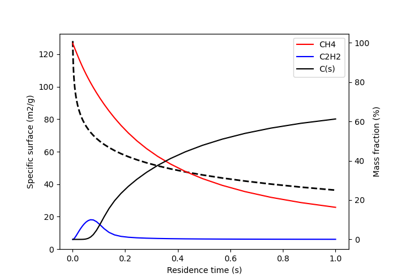
- class bloc.reactors.CarbonBlackIdealGasMoleReactor(*args, **kwargs)#
Bases:
cantera.ExtensibleIdealGasMoleReactorIdealGasMoleReactor with additional features for carbon quality calculations.
This class extends the
cantera.IdealGasMoleReactorclass to include additional features for carbon quality calculations. The class is intended to be used in Reactor Networks.Examples
- residence_time#
Residence time in (s). Residence time must be set by the user during simulation.
- after_initialize(t0)#
- guess_specific_surface(Model=KirkOthmer2004SurfaceArea)#
Evaluate the specific surface of the carbon based on temperature and residence time.
Note
The residence time must be calculated before calling this method; for instance with:
reactor.residence_time = reactor.volume / flow_rate
Or:
for t in logspace(0.001, 1, 50):  # s
    sim.advance(t)
    reactor.residence_time = t
- Parameters:
Model (
class) – Surface area model to use. Default isKirkOthmer2004SurfaceArea.
Examples
- class bloc.reactors.CarbonBlackIdealGasReactor(*args, **kwargs)#
Bases:
cantera.ExtensibleIdealGasReactorIdealGasReactor with additional features for carbon quality calculations.
This class extends the
cantera.IdealGasReactorclass to include additional features for carbon quality calculations. The class is intended to be used in Reactor Networks.Examples
- residence_time#
Residence time in (s). Residence time must be set by the user during simulation.
- after_initialize(t0)#
- guess_specific_surface(Model=KirkOthmer2004SurfaceArea)#
Evaluate the specific surface of the carbon based on temperature and residence time.
Note
The residence time must be calculated before calling this method; for instance with:
reactor.residence_time = reactor.volume / volumetric_flow_rate
Or:
for t in logspace(0.001, 1, 50):  # s
    sim.advance(t)
    reactor.residence_time = t
- Parameters:
Model (
class) – Surface area model to use. Default isKirkOthmer2004SurfaceArea.
Examples
- bloc.reactors.is_psr_mixing_kind(kind)#
Return True when kind is a registered STONE kind for any PSR-family mixer.
“Any PSR-family mixer” means
PSRor a subclass — e.g. the SPRINGContinuousMixingReactor(TMR) andInstantaneousMixingReactorkinds.
- class bloc.reactors.ContinuousMixingReactor(gas, *args, **kwargs)#
Bases:
bloc.reactors.stirred.PSRIndustrial Torch Mixing Reactor (TMR) / multi-inlet well-mixed vessel.
A perfectly stirred reactor (see
PSR) used to model the turbulent mixing of two or more streams at the outlet of a plasma torch.STONE kind:
ContinuousMixingReactor. Node id in SPRING YAML:tmr(the TMR in SPRING A3/A4).Use this kind for any well-mixed stage where axial gradients are negligible. Assume Da_mix ≫ 1: mixing inside the vessel is faster than chemistry so the CSTR approximation holds.
Network topology#
Stage YAML: OPEN — multi-inlet MFCs, outlet PC/MFC; solved with
ReactorNetandadvance_to_steady_state(default).Inner physics: OPEN CSTR.
t_res_ssizes volume via Bloc post-build (_post_build_design_volumes(),V = τ·ṁ/ρ); it is the design residence time, not the stageadvance_time.See also
PSRunderlying numerical engine.
InstantaneousMixingReactorclosed-parcel alternative when inlet streams are pre-mixed algebraically before chemistry.
- NETWORK_CLASS = None#
- before_update_state(y)#
Inject a pending initial state into CVODE’s
ybefore the first eval.Cantera’s
Reactor::initialize()restoresm_state(the state snapshot taken at construction time) via a direct C++ call that bypasses all Python delegates. The only reliable interception point is here: CVODE callsupdateState(y)just before its firsteval, andyis writable.If
_pending_initis set, this method overwritesywith values derived from the HP-corrected gas state and clears the flag. All subsequentupdateStatecalls (driven by CVODE’s own stepping) are unaffected.
- class bloc.reactors.InstantaneousMixing(gas, *args, **kwargs)#
Bases:
bloc.reactors.stirred.PSREngine: instantaneous HP mix of two inlet streams + closed-τ chemistry.
Step 1 — inlet streams are combined with constant-HP algebraic mixing (
mix_two_streams()), reproducing theDa_mix ≫ 1assumption (turbulent mixing much faster than chemistry):\[\dot m = \dot m_1 + \dot m_2, \qquad h = \frac{\dot m_1 h_1 + \dot m_2 h_2}{\dot m}, \qquad Y_k = \frac{\dot m_1 Y_{k,1} + \dot m_2 Y_{k,2}}{\dot m}\]at unchanged \(P\); the mixed temperature follows from the \((h, P, Y_k)\) inversion — no chemistry yet.
Step 2 — a closed constant-pressure parcel integrates the ODE from
t = 0tot = t_res_swith no inlet/outlet mass exchange:\[\frac{dn_k}{dt} = V \dot\omega_k, \qquad m\,c_p\,\frac{dT}{dt} = -V \sum_k \bar h_k \dot\omega_k\]This formalises the legacy pattern:
gas_mixed = mix_two_streams(gas_1, qm_1, gas_2, qm_2)
PSR_simu = solve_adiabatic_reactor(qm_total, 0, t_res_s, ...)
- _states#
Residence-time profile recorded by
solve_premixed().- Type:
ct.SolutionArrayorNone
- NETWORK_CLASS: ClassVar[type | None] = None#
- solve_premixed(gas_1, qm_1, gas_2, qm_2, t_res_s, *, verbose=True)#
HP-mix two inlet streams then integrate closed chemistry for t_res_s.
- Parameters:
gas_1 – Cantera Solution objects for the two inlet streams (same or different mechanisms; both must be on the stage mechanism before calling — species mapping is the caller’s responsibility).
gas_2 – Cantera Solution objects for the two inlet streams (same or different mechanisms; both must be on the stage mechanism before calling — species mapping is the caller’s responsibility).
qm_1 – Mass flow rates [kg/s] of each stream.
qm_2 – Mass flow rates [kg/s] of each stream.
t_res_s – Chemical residence time [s]; CVODE integrates 0 → t_res_s on a closed parcel (no MFC flux during integration).
verbose – Print outlet state summary.
- Returns:
- before_update_state(y)#
Inject a pending initial state into CVODE’s
ybefore the first eval.Cantera’s
Reactor::initialize()restoresm_state(the state snapshot taken at construction time) via a direct C++ call that bypasses all Python delegates. The only reliable interception point is here: CVODE callsupdateState(y)just before its firsteval, andyis writable.If
_pending_initis set, this method overwritesywith values derived from the HP-corrected gas state and clears the flag. All subsequentupdateStatecalls (driven by CVODE’s own stepping) are unaffected.
- class bloc.reactors.InstantaneousMixingNet(reactors, meta=None)#
Bases:
cantera.ReactorNetReactorNet subclass for instantaneous-mix + closed-τ chemistry.
Mirrors
TorchInstantaneousHeatingNet: the stage network holds no live ODE reactors.advance()only validates that_post_build_design_volumes()has pre-computed the outlet profile.- Parameters:
reactors – Stage reactor list. Must contain exactly one
InstantaneousMixinginstance.meta (
dict, optional) – Parameters from the STONE builder, enriched by_post_build_design_volumes():t_res_s,mass_flow_rate.
- role: ClassVar[str] = 'PSR'#
- advance_to_steady_state()#
Validate precomputed outlet and delegate.
- solve_steady()#
Delegate steady solve to
advance_to_steady_state().
- advance(time)#
Validate precomputed outlet profile from post-build.
- Parameters:
time – Nominal advance time [s]; unused, kept for API compatibility.
- property states: cantera.SolutionArray | None#
Closed-τ residence-time profile (satisfies
CustomStageNetwork).
- property scalars: Dict[str, Any]#
Build parameters and outlet-state scalars.
- class bloc.reactors.InstantaneousMixingReactor(gas, *args, **kwargs)#
Bases:
InstantaneousMixingIndustrial model: instantaneous mix + closed chemical residence time.
Two inlet streams (e.g. torch primary + secondary injection) are combined with constant-HP algebraic mixing (
mix_two_streams()), then chemistry runs fort_res_sin a closed well-mixed parcel.STONE kind:
InstantaneousMixingReactor.Use when Da_mix ≫ 1 (turbulent mixing time ≪ chemical timescale) and the workflow is a one-shot feedforward chain (not a continuously-fed vessel). For a continuously-fed open CSTR, use
ContinuousMixingReactorinstead.Network topology#
Stage YAML: OPEN — two inlet MFCs (source reservoirs or upstream reactor outlets), outlet MFC/PressureController for downstream handoff.
Inner physics: CLOSED parcel.
_post_build_design_volumes()gathers both inlet states, callssolve_premixed(), and writes back toreactor.phase+syncState(). No live ODE in the stage ReactorNet.See also
ContinuousMixingReactoropen CSTR alternative (continuous feed/discharge).
mix_two_streamsalgebraic HP mixer used in step 1.
- NETWORK_CLASS: ClassVar[type | None] = None#
- solve_premixed(gas_1, qm_1, gas_2, qm_2, t_res_s, *, verbose=True)#
HP-mix two inlet streams then integrate closed chemistry for t_res_s.
- Parameters:
gas_1 – Cantera Solution objects for the two inlet streams (same or different mechanisms; both must be on the stage mechanism before calling — species mapping is the caller’s responsibility).
gas_2 – Cantera Solution objects for the two inlet streams (same or different mechanisms; both must be on the stage mechanism before calling — species mapping is the caller’s responsibility).
qm_1 – Mass flow rates [kg/s] of each stream.
qm_2 – Mass flow rates [kg/s] of each stream.
t_res_s – Chemical residence time [s]; CVODE integrates 0 → t_res_s on a closed parcel (no MFC flux during integration).
verbose – Print outlet state summary.
- Returns:
- before_update_state(y)#
Inject a pending initial state into CVODE’s
ybefore the first eval.Cantera’s
Reactor::initialize()restoresm_state(the state snapshot taken at construction time) via a direct C++ call that bypasses all Python delegates. The only reliable interception point is here: CVODE callsupdateState(y)just before its firsteval, andyis writable.If
_pending_initis set, this method overwritesywith values derived from the HP-corrected gas state and clears the flag. All subsequentupdateStatecalls (driven by CVODE’s own stepping) are unaffected.
- class bloc.reactors.InstantaneousQuenchReactor(gas, *args, **kwargs)#
Bases:
InstantaneousMixingIndustrial model: quench a hot stream to a target outlet temperature.
One real inlet stream (the hot gas) is mixed with a quench gas of known composition/temperature; the quench mass flow is solved for (
find_quench_flow()) so the mixed outlet hitstarget_temperature_C, then chemistry runs fort_res_sin a closed well-mixed parcel — the same closed-τ mechanics asInstantaneousMixingReactor, just with the unknown on the other side: quench solves for a flow given a target temperature, the other kind solves for the resulting temperature given both flows.STONE kind:
InstantaneousQuenchReactor.Network topology#
Stage YAML: OPEN — exactly one inlet MFC (the upstream hot-gas source), outlet MFC/PressureController for downstream handoff. The quench gas is not a separate inlet connection: its temperature and composition are properties of this node itself (
T_quench_C,X_quench).Inner physics: CLOSED parcel, identical to
InstantaneousMixingReactor— see_build_instantaneous_quench_reactor()for how the missing quench flow is solved beforesolve_premixed()runs.See also
InstantaneousMixingReactorboth-flows-fixed alternative.
find_quench_flow()closed-form flow solve.
- NETWORK_CLASS: ClassVar[type | None] = None#
- solve_premixed(gas_1, qm_1, gas_2, qm_2, t_res_s, *, verbose=True)#
HP-mix two inlet streams then integrate closed chemistry for t_res_s.
- Parameters:
gas_1 – Cantera Solution objects for the two inlet streams (same or different mechanisms; both must be on the stage mechanism before calling — species mapping is the caller’s responsibility).
gas_2 – Cantera Solution objects for the two inlet streams (same or different mechanisms; both must be on the stage mechanism before calling — species mapping is the caller’s responsibility).
qm_1 – Mass flow rates [kg/s] of each stream.
qm_2 – Mass flow rates [kg/s] of each stream.
t_res_s – Chemical residence time [s]; CVODE integrates 0 → t_res_s on a closed parcel (no MFC flux during integration).
verbose – Print outlet state summary.
- Returns:
- before_update_state(y)#
Inject a pending initial state into CVODE’s
ybefore the first eval.Cantera’s
Reactor::initialize()restoresm_state(the state snapshot taken at construction time) via a direct C++ call that bypasses all Python delegates. The only reliable interception point is here: CVODE callsupdateState(y)just before its firsteval, andyis writable.If
_pending_initis set, this method overwritesywith values derived from the HP-corrected gas state and clears the flag. All subsequentupdateStatecalls (driven by CVODE’s own stepping) are unaffected.
- class bloc.reactors.PlasmaTorchInstantaneousHeating(gas, *args, **kwargs)#
Bases:
TorchInstantaneousHeatingIndustrial Plasma Torch model — instantaneous-heating variant.
Instantaneous enthalpy jump (plasma power input at
eta * P_torch) followed by adiabatic constant-pressure kinetics fort_res_s(seeTorchInstantaneousHeating).STONE kind:
PlasmaTorchInstantaneousHeating.The
InstantaneousHeatingsuffix distinguishes this model from future plasma-torch implementations that may use a different heating model (e.g., arc-discharge, spatially-resolved, or multi-temperature).Use this kind for all plasma torch stages where the heating is quasi-instantaneous compared to the chemical relaxation time.
See also
TorchInstantaneousHeatingunderlying physics class.
- NETWORK_CLASS: ClassVar[type | None] = None#
- property SEI_MJ_kg: float | None#
Specific Energy Input [MJ/kg] from
_meta(electrical input / feed).Available on every torch once
_post_build_design_volumes()has populatedelectric_power_kWandmass_flow_rateon_meta.
- property SEO_MJ_kg: float | None#
Specific Energy Output [MJ/kg] from
_meta(thermal power to gas / feed).
- solve_adiabatic(mdot, power_kW, t_res_s, verbose=True)#
Solve adiabatic kinetics using this reactor’s current inlet state.
Adds torch power as an enthalpy jump and integrates one adiabatic pass for
t_res_susing a freshtype(self)(gas, clone=False)carrier.
- add_energy_stream(stream)#
Attach an
EnergyStreamrecord to this reactor.
- property energy_inlets: list[EnergyStream]#
Energy streams currently flowing into this reactor (power_w > 0).
- property energy_outlets: list[EnergyStream]#
Energy streams currently flowing out of this reactor (power_w < 0).
- class bloc.reactors.TorchInstantaneousHeating(gas, *args, **kwargs)#
Bases:
bloc.reactors.energy_stream.EnergyPortMixin,cantera.IdealGasConstPressureMoleReactorTorch physics engine with instantaneous enthalpy jump (plasma / simplified).
Boulder’s
build_sub_networkdetectsNETWORK_CLASSand instantiatesTorchInstantaneousHeatingNetfor the torch stage. That class uses the same physics as the legacysimulation_non_isothermal_reactorspath: instantaneous enthalpy addition (gas.HP += Q/mdot) followed by adiabatic kinetics fort_res_s.Physics#
The heating device is collapsed into a single algebraic enthalpy jump at the inlet — the \(\mathrm{Da} \gg 1\) limit for heating, where the power is deposited on a timescale much shorter than the chemistry it drives — followed by an adiabatic constant-pressure relaxation of a closed parcel over
t_res_s.Step 1, effective power reaching the gas:
\[P_{eff} = \eta_{torch}\,\eta_{gen}\,P_{elec}\]Step 2, instantaneous enthalpy increase at constant pressure (
gas.HP = gas.h + power_kW * 1e3 / mdot, gas.Pinsolve_adiabatic()):\[h^{+} = h^{-} + \frac{P_{eff}}{\dot m}, \qquad P^{+} = P^{-}\]so the specific enthalpy gain of the stream is exactly the specific energy output, \(\Delta h = P_{eff}/\dot m = \mathrm{SEO}\); the post-jump temperature is the \((h^{+}, P)\) inversion of the mixture.
Step 3, adiabatic closed-parcel chemistry (no wall, no ambient loss):
\[\frac{dn_k}{dt} = V \dot\omega_k, \qquad m\,c_p\,\frac{dT}{dt} = -V \sum_k \bar h_k \dot\omega_k, \qquad 0 \le t \le t_{res}\]Specific energies, exposed as
SEI_MJ_kg/SEO_MJ_kg:\[\mathrm{SEI} = \frac{P_{elec}}{\dot m}, \qquad \mathrm{SEO} = \frac{P_{eff}}{\dot m} = \eta_{torch}\,\eta_{gen}\,\mathrm{SEI}\]- _meta#
Torch parameters populated by
_build_torch_instantaneous()and enriched by_post_build_design_volumes().- Type:
dict
- _states#
Residence-time profile written by
solve_adiabatic()(extrat[s]).- Type:
ct.SolutionArrayorNone
See also
- NETWORK_CLASS: ClassVar[type | None]#
- property SEI_MJ_kg: float | None#
Specific Energy Input [MJ/kg] from
_meta(electrical input / feed).Available on every torch once
_post_build_design_volumes()has populatedelectric_power_kWandmass_flow_rateon_meta.
- property SEO_MJ_kg: float | None#
Specific Energy Output [MJ/kg] from
_meta(thermal power to gas / feed).
- solve_adiabatic(mdot, power_kW, t_res_s, verbose=True)#
Solve adiabatic kinetics using this reactor’s current inlet state.
Adds torch power as an enthalpy jump and integrates one adiabatic pass for
t_res_susing a freshtype(self)(gas, clone=False)carrier.
- add_energy_stream(stream)#
Attach an
EnergyStreamrecord to this reactor.
- property energy_inlets: list[EnergyStream]#
Energy streams currently flowing into this reactor (power_w > 0).
- property energy_outlets: list[EnergyStream]#
Energy streams currently flowing out of this reactor (power_w < 0).
- class bloc.reactors.TorchInstantaneousHeatingNet(reactors, meta=None)#
Bases:
cantera.ReactorNetReactorNet subclass implementing torch adiabatic integration.
Mirrors the
PFRHomogeneousShellNetpattern: overridesadvance()so the torch stage runs the same physics as the legacysimulation_non_isothermal_reactorspath — instantaneous enthalpy addition followed by adiabatic kinetics fort_res_s.- Parameters:
reactors – List of reactors for this stage. Must contain exactly one
TorchInstantaneousHeating.meta (
dict, optional) – Parameters injected by_build_torch_instantaneous()and enriched by_post_build_design_volumes():effective_power_kW,mass_flow_rate,t_res_s,mechanism.
- role: ClassVar[str] = 'torch'#
- advance_to_steady_state()#
Validate that precomputed torch outlet data is available.
This stage does not integrate dynamics here; the outlet profile is precomputed in
_post_build_design_volumes().
- solve_steady()#
Delegate steady solve to
advance_to_steady_state().Base
ReactorNetwould run on an empty reactor list and raise.
- advance(time)#
Validate and expose the precomputed torch outlet.
_post_build_design_volumes()pre-computes a torch outlet profile and stores_statesbefore thisTorchInstantaneousHeatingNetis instantiated. Downstream extraction readstorch.phaseaftersolve_adiabatic()writeback.- Parameters:
time – Nominal advance time [s], unused and kept for API compatibility.
- property states: cantera.SolutionArray | None#
Adiabatic post-enthalpy profile (satisfies
CustomStageNetwork).
- property scalars: Dict[str, Any]#
Torch build parameters and outlet-state physics quantities.
- bloc.reactors.compute_torch_sei_mj_kg(electric_power_kW, mdot_kg_s)#
Specific Energy Input [MJ/kg] = electrical input per kg of feed.
SEI = electric_power_kW·1e3 / mdot / 1e6. ReturnsNonewhenmdot_kg_sis not positive.
- bloc.reactors.compute_torch_seo_mj_kg(effective_power_kW, mdot_kg_s)#
Specific Energy Output [MJ/kg] = thermal power to gas per kg of feed.
SEO = effective_power_kW·1e3 / mdot / 1e6whereeffective_power_kW = electric_power_kW × torch_eff × gen_eff. Matches theSEO_torchKPI inbloc.reporting.spring_kpi. ReturnsNonewhenmdot_kg_sis not positive.
- bloc.reactors.is_torch_reactor_kind(kind)#
Return True when kind is a registered STONE kind for any torch.
“Any torch” means
TorchInstantaneousHeatingor a subclass — the base engine,PlasmaTorchInstantaneousHeating, and any supplier catalog model built on it (e.g.PBR100PlasmaTorch).
- class bloc.reactors.PFRWallProfileNet(reactors, meta=None, *, wall_T_fn=None, total_length=None, n_points=200, rtol=0.0001, atol=1e-12)#
Bases:
bloc.reactors.pfr_networks._LagrangianDuckTypedNetMixinStage network driving a
TubeFurnacethrough a prescribed wall profile.Replaces the legacy
LagrangianPFRReactor+LagrangianPFRNetwork+DesignTubeFurnaceNettrio with a single driver built on the unifiedPFRWallProfileengine and the sharedmarch_lagrangian_parcel()marcher.Physics#
A closed Lagrangian gas parcel is marched from inlet to outlet. At each spatial checkpoint the wall temperature
T_wall(x)and the entry-length positionx_position = max(x - heating_start, 0)are pushed onto the carrier; theafter_eval()hook then injects forced-convection + grey-gas-radiation flux into the energy ODE.Numerics#
Unlike the retired adaptive
net.steploop, this driver uses the fixed-checkpointnet.advancemarch (n_pointsdefault 200), which yields a uniform spatial grid and reproduces the experimentally-validated (Mei 2019) profiles within < 1 %. Spatial resolution is controlled byn_pointsalone; inner CVODE step size is left to the integrator.The public surface is duck-typed to Boulder’s
CustomStageNetwork(time,states,scalars,advance,advance_to_steady_state) and exposes the tube-furnace diagnostics (E_conv,E_rad,n_steps,h_conv_avg,Fo_D_minand the recorded*_arrprofiles) consumed bycompute_tube_furnace_kpis(),report_detailsandyaml_utils.- param reactors:
Iterable containing exactly one
TubeFurnace(PFRWallProfile) reactor.- param meta:
Geometry / wall-profile parameters produced by
_build_design_tube_furnace()(total_length,T_wall_K,T_ambient_K,entry_leg,exit_leg,entry_zone,plateau_zone,T_wall_profile,diameter,kappa_grey).- type meta:
dict, optional
- role: ClassVar[str] = 'furnace'#
- report_states: ClassVar[bool] = False#
- FO_PROFILE_KEYS: ClassVar[tuple[str, ...]] = ('x_arr', 'T_wall_arr', 'T_gas_arr', 'alpha_arr', 'k_arr', 'u_arr', 'Re_arr', 'Pr_arr',...#
- NETWORK_DIAGRAM_NOTE: str = 'Node temperatures in this diagram reflect the outlet gas state of the Lagrangian simulation...#
- model_notes()#
Return the physical models and numerics this stage used, one line each.
Consumed by the calculation note’s Notes sheet (see
bloc.reporting.orchestrator_stone._stone_model_notes_from_sim()). States what was actually used: the convection correlations are the ones the march recorded checkpoint by checkpoint, with the Reynolds range over which each applied, not a static description.
- fo_profile()#
Return the axial thermal-homogeneity profile as plain float lists.
JSON-safe, so the profile survives the Calculation Note’s cached bundle. The Excel table used to be rendered straight off a live network object, which only the retired ctwrap path ever provided, so it never appeared in a STONE export.
Returns None before the march has run.
- reactors#
- E_conv: float = 0.0#
- E_rad: float = 0.0#
- E_total: float = 0.0#
- n_steps: int = 0#
- h_conv_avg: float#
- Fo_D_min: float#
- x_arr: numpy.ndarray | None = None#
- t_arr: numpy.ndarray | None = None#
- T_wall_arr: numpy.ndarray | None = None#
- T_gas_arr: numpy.ndarray | None = None#
- Y_Cs_arr: numpy.ndarray | None = None#
- X_arr: numpy.ndarray | None = None#
- species_names: list[str] | None = None#
- Fo_D_arr: numpy.ndarray | None = None#
- h_conv_arr: numpy.ndarray | None = None#
- alpha_arr: numpy.ndarray | None = None#
- u_arr: numpy.ndarray | None = None#
- k_arr: numpy.ndarray | None = None#
- Re_arr: numpy.ndarray | None = None#
- Pr_arr: numpy.ndarray | None = None#
- property reactor: bloc.reactors.plug_flow.PFRWallProfile#
The single PFRWallProfile/TubeFurnace reactor (used by plot helpers).
- advance_to_steady_state()#
Run the fixed-checkpoint parcel march from inlet to outlet.
The full axial
cantera.SolutionArrayis attached to the reactor as_states(consumed by Boulder’s stage-state collector andspatial_series_fn). Idempotent: a second call is a no-op.
- property states: cantera.SolutionArray | None#
Axial Lagrangian profile (satisfies Boulder’s stage-state collector).
- property scalars: Dict[str, Any]#
Tube-furnace scalars (wall energy budget, residence time, meta).
- export_cfd_conditions()#
Export the tube-furnace trajectory as CFD initial/boundary conditions.
Returns a dict with all the state arrays and scalars needed by Avalanche to render the OpenFOAM case: inlet T, p, composition, mass flow rate, wall T profile (x, T_wall), axial velocity, Re, residence time, diameter, and length.
The node must already have been solved (via
advance_to_steady_state()orbuild_simulation_from_yaml()). This method does not re-run the 1-D solve; it only reads the cached trajectory arrays.- Returns:
CFD-relevant state from the solved tube-furnace trajectory.
- Return type:
dict
- draw(title='Tube Furnace — Wall Temperature Profile', n_points=200)#
Return a schematic matplotlib Figure of the tube-furnace geometry.
Upper panel: colour-coded tube rectangle (cold→hot→cold). Lower panel: wall (and, post-advance, gas) temperature profile. Does not require
advance()— relies only onwall_T_fn/total_length.
- plot_temperature_profile(title='Temperature Profile — Tube Furnace')#
Plot gas + wall temperature vs position with a residence-time axis.
Requires
advance_to_steady_state()to have been called.
- plot_reynolds_profile(title='Reynolds Number — Tube Furnace')#
Plot the local Reynolds number vs position, with the laminar limit.
Re = mdot D / (A mu), evaluated at the local gas state along the march, so it tracks the viscosity rise as the gas heats. Re = 2300 is drawn for reference: below it the flow is laminar and the convection correlation falls back to a constant Nusselt number.Requires
advance_to_steady_state()to have been called.
- plot_species_profiles(species=None, title='Species Profile — Tube Furnace')#
Plot mole-fraction profiles vs position with a residence-time axis.
Requires
advance_to_steady_state()to have been called. WhenspeciesisNone, the six species with the highest peak mole fraction (≥ 0.1 %) are selected automatically.
- property mass_flow_rate: float#
Mass flow rate [kg/s] of the driven reactor.
- property network#
Self-reference kept for backward compatibility with diagnostics readers.
- property time: float#
Residence time [s] of the Lagrangian march (0 before advance).
- property preconditioner#
Preconditioner is managed inside march_lagrangian_parcel; exposed for symmetry.
- solve_steady()#
Delegate to
advance_to_steady_state()for Bouldersolve_steady.
- advance(t=1.0)#
Advance to
t; for a Lagrangian tube this runs to the outlet.
- class bloc.reactors.SootRadiatingTubeFurnace(gas, *args, clone=False, diameter=0.1, kappa_grey=0.0, mass_flow_rate=0.0, soot_density=1800.0, n_C_min=None, **kwargs)#
Bases:
TubeFurnaceTube furnace with soot-augmented grey-gas radiation.
Overrides the energy-balance hook so the radiative flux uses an effective absorption coefficient
kappa = kappa_grey + kappa_sootevaluated from the local gas state, instead of the fixedself.kappa_greyused by the base class.kappa_greytherefore carries the clean-gas baseline.Soot contribution uses the Planck-mean grey-gas correlation (Rodrigues):
\[\kappa_{soot} = 3.83\,\frac{C_0}{C_2}\,f_v\,T\]where:
\(f_v = Y_{soot}\,\rho_{gas}/\rho_{soot}\) is the local soot volume fraction, with \(Y_{soot}\) the summed solid-carbon mass fraction, \(\rho_{gas}\) the gas density, and \(\rho_{soot}\) the soot particle density (
soot_density, default 1800 kg/m³).\(C_0 = 6\pi\,E(m)\) is the soot optical constant, with \(E(m) \approx 0.260\) the soot absorption function (dimensionless). Implemented as
_SOOT_C0 = 6 * pi * 0.260.\(C_2 = hc/k_B\) is the second radiation constant (Planck law), \(C_2 \approx 0.014388\) m·K. Implemented as
_SOOT_C2.
The prefactor 3.83 and the \(C_0/C_2\) grouping are folded into
_SOOT_KAPPA_COEFFin code.References
Rodrigues, P. Modélisation multiphysique de flammes turbulentes suitées avec la prise en compte des transferts radiatifs et des transferts de chaleur pariétaux.
- soot_density#
- n_C_min = None#
- wall_heat_terms()#
Return
(Q_conv, Q_rad, h_conv, kappa_eff)for the current state.See
PFRWallProfile.wall_heat_terms():after_evalruns inside the solver’s right-hand-side evaluations, so_last_Q_convis whichever trial or Jacobian-perturbation state came last. Reporting code must call this instead.
- after_eval(t, LHS, RHS)#
Inject wall convection + soot-augmented grey-gas radiation.
- NETWORK_CLASS: ClassVar[type | None] = None#
- SOLVER_MODE: ClassVar[str] = 'adaptive'#
- diameter = 0.1#
- kappa_grey = 0.0#
- mass_flow_rate = 0.0#
- T_wall_K: float | None = None#
- x_position: float = 0.0#
- before_update_state(y)#
Inject a pending initial state into CVODE’s
ybefore the first eval.
- heat_flux_factory(carrier)#
Return a heat-flux callable
Q(t) [W/m²]for this wall model.Override in subclasses to provide the wall heat-transfer law. Return
Nonefor an adiabatic parcel.- Parameters:
carrier – The fresh closed-carrier instance created by
build_closed_carrier_net(). Subclasses may read carrier attributes (diameter,phase,_meta, …) to build the closure.
- add_energy_stream(stream)#
Attach an
EnergyStreamrecord to this reactor.
- property energy_inlets: list[EnergyStream]#
Energy streams currently flowing into this reactor (power_w > 0).
- property energy_outlets: list[EnergyStream]#
Energy streams currently flowing out of this reactor (power_w < 0).
- class bloc.reactors.TubeFurnace(gas, *args, clone=False, diameter=0.1, kappa_grey=0.0, mass_flow_rate=0.0, **kwargs)#
Bases:
bloc.reactors.plug_flow.PFRWallProfileIndustrial Tube Furnace model.
A plug-flow reactor heated by an externally prescribed wall-temperature profile
T_wall(x)using forced convection and grey-gas radiation (seePFRWallProfile).STONE kind:
TubeFurnace. For the STONE YAML schema seeTubeFurnaceSchema.Use this kind for any electrically or indirectly heated tube where the wall temperature profile is known or measured. The Carbon-Black tube furnace (Mei-2019 validation) is the canonical example.
See also
PFRWallProfileunderlying numerical engine.
RefractoryReactorinsulated thick-shell reactor (SPRING CGR).
- NETWORK_CLASS: ClassVar[type | None] = None#
- SOLVER_MODE: ClassVar[str] = 'adaptive'#
- diameter = 0.1#
- kappa_grey = 0.0#
- mass_flow_rate = 0.0#
- T_wall_K: float | None = None#
- x_position: float = 0.0#
- wall_heat_terms()#
Return
(Q_conv, Q_rad, h_conv, kappa)for the current phase state.after_evalis an ODE right-hand-side hook, so the solver also calls it for trial steps it later rejects and for every finite-difference Jacobian column._last_Q_convtherefore holds whatever perturbed state was evaluated last, which is not the accepted solution and is not reproducible across machines. Anything reporting these terms must recompute them from the accepted state by calling this.
- after_eval(t, LHS, RHS)#
Inject wall convection + radiation into the energy ODE RHS.
- before_update_state(y)#
Inject a pending initial state into CVODE’s
ybefore the first eval.
- heat_flux_factory(carrier)#
Return a heat-flux callable
Q(t) [W/m²]for this wall model.Override in subclasses to provide the wall heat-transfer law. Return
Nonefor an adiabatic parcel.- Parameters:
carrier – The fresh closed-carrier instance created by
build_closed_carrier_net(). Subclasses may read carrier attributes (diameter,phase,_meta, …) to build the closure.
- add_energy_stream(stream)#
Attach an
EnergyStreamrecord to this reactor.
- property energy_inlets: list[EnergyStream]#
Energy streams currently flowing into this reactor (power_w > 0).
- property energy_outlets: list[EnergyStream]#
Energy streams currently flowing out of this reactor (power_w < 0).
- bloc.reactors.compute_tube_furnace_kpis(sim)#
Compute tube-furnace engineering KPIs from a solved STONE Simulation.
Bridges the STONE/Boulder path to the same output key set as
bloc.yaml_utils._tf_kpi_extractor()(the ctwrap path), so thatrun_yaml_scenarios.pyand the legacy ctwrap runner produce the same Calculation Note Excel.Looks for a
PFRWallProfileNetinsim.network.networks(the stage solver mapping). All scalars are read from that network, which is populated duringadvance_to_steady_state.- Parameters:
sim (
bloc.simulation_builder.Simulation) – Solved STONE simulation returned bybloc.simulation_builder.build_simulation_from_yaml().- Returns:
Flat scalar dict with keys matching
bloc.yaml_utils.TF_OUTPUT_VARIABLE_MAP(T_outlet_C,E_conv_J,E_rad_J,P_conv_avg_W,P_rad_avg_W,SEO_MJ_kg,n_steps,h_conv_avg_W_m2_K,Fo_D_min,diameter_mm,t_res_s) plus per-species gas-phase mole (X_*) and mass (Y_*) fractions (solid carbon excluded and renormalised, reported separately asX_C(s)/Y_C(s)) and, when the feed carries H or C, the performance KPIs shared with the SPRING calc note (H2_yield,C(s)_yield,CH4_conversion,H2_production,C(s)_production,Ecost_H2 (kWh/kgH2)). With a torch stage upstream the performance KPIs are referenced to the process feed and the torch energy rows are added (G_PW_IN (kW),TP_PW_OUT (kW),SEI_torch (MJ/kg),SEO_torch (MJ/kg));Ecost_H2then uses the generator electric power as in the SPRING calc note. Returns an empty dict when noPFRWallProfileNetis found insim.network.networks.- Return type:
dict