
bloc.chem.heat_transfer#
Heat transfer correlations and utilities for reactor modeling.
This module consolidates all heat transfer functions used in Bloc: external natural convection, linearized radiation, thermal resistance networks, gas-to-wall radiative flux, and internal forced convection.
Internal convection evaluates the individual correlation functions of the
ht library [CalebBell_ht] — laminar_entry_Baehr_Stephan
and turbulent_Gnielinski,
with the friction factor from fluids.friction.Clamond.
Which correlation applies is decided here rather than by ht’s own
selector Nu_conv_internal; internal_nusselt() gives the reason.
References
Caleb Bell and Contributors (2016-2025). ht: Heat transfer component of Chemical Engineering Design Library (ChEDL). CalebBell/ht — docs at https://ht.readthedocs.io/
Attributes#
Upper Reynolds number of laminar pipe flow (VDI Heat Atlas, Gnielinski). |
|
Lower Reynolds number of fully turbulent pipe flow (VDI Heat Atlas). |
|
Fully developed laminar Nusselt number for a constant wall temperature. |
|
Shortest entry length a thermal-entry correlation is evaluated at, in D. |
|
Classes#
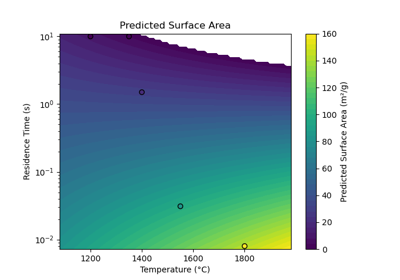
Predicts the surface area of carbon based on temperature and residence time. |
Functions#
|
Thermal resistance for radial conduction in cylindrical geometry. |
|
Thermal resistance of a conducto-convective heat transfer surface. |
|
Natural convection coefficient at the external wall of a vertical cylinder. |
|
Natural convection coefficient at the external wall of a horizontal cylinder. |
|
Linearized radiative conductance for small temperature differences. |
|
Solve heat transfer through a series thermal resistance stack. |
|
Radiative flux from a participating gas to the tube wall in W/m2. |
|
Nusselt number for forced convection inside a circular tube, by regime. |
|
Compute the internal forced-convection coefficient h = Nu k / D in a tube. |
Module Contents#
- bloc.chem.heat_transfer.g = 9.81#
- bloc.chem.heat_transfer.sigma_SB = 5.67e-08#
- bloc.chem.heat_transfer.nu_air_20C = 1.589e-05#
- bloc.chem.heat_transfer.alpha_air_20C = 2.25e-05#
- bloc.chem.heat_transfer.conductivity_air_20C = 0.0263#
- bloc.chem.heat_transfer.Pr_air_20C = 0.707#
- bloc.chem.heat_transfer.thermal_resistance_radial_conduction(diameter, length, conductivity, e_insulation)#
Thermal resistance for radial conduction in cylindrical geometry.
\[R = \frac{\ln(r_2/r_1)}{2\pi k L}, \quad r_1 = D/2, \quad r_2 = D/2 + e_{\mathrm{insulation}}\]- Parameters:
diameter (
float) – Inner diameter in m.length (
float) – Cylinder length in m.conductivity (
float) – Thermal conductivity of insulation in W/m/K.e_insulation (
float) – Insulation thickness in m.
- Returns:
Thermal resistance in K/W.
- Return type:
float
- bloc.chem.heat_transfer.thermal_resistance_CC(h_CC, S)#
Thermal resistance of a conducto-convective heat transfer surface.
\[R = \frac{1}{h_{\mathrm{CC}} \, S}\]- Parameters:
h_CC (
float) – Heat transfer coefficient in W/m2/K.S (
float) – Surface area in m2.
- Returns:
Thermal resistance in K/W.
- Return type:
float
- bloc.chem.heat_transfer.compute_hCC_natConv_vertCyl(diameter, length, T_wall_C, T_amb_C, conductivity=conductivity_air_20C, nu=nu_air_20C, alpha=alpha_air_20C, Pr=Pr_air_20C)#
Natural convection coefficient at the external wall of a vertical cylinder.
Correlation from Taine / Lefevre (1956).
Warning
Valid for laminar flow only; gives low h values.
\[ \begin{align}\begin{aligned}\mathrm{Ra}_L = \frac{g \beta (T_{\mathrm{wall}} - T_{\mathrm{amb}}) L^3}{\nu \alpha}\\\mathrm{Nu} = \frac{4}{3} \left(\frac{7 \mathrm{Ra}_L \mathrm{Pr}}{100 + 105 \mathrm{Pr}}\right)^{1/4} + 0.1143 \frac{272 + 315 \mathrm{Pr}}{64 + 63 \mathrm{Pr}} \frac{L}{D}, \quad h = \frac{\mathrm{Nu} \, k}{L}\end{aligned}\end{align} \]- Parameters:
diameter (
float) – Outer diameter in m.length (
float) – Cylinder length in m.T_wall_C (
float) – Wall temperature in deg C.T_amb_C (
float) – Ambient temperature in deg C.conductivity (
float, optional) – Fluid thermal conductivity in W/m/K. Defaults to air at 20 deg C.nu (
float, optional) – Kinematic viscosity in m2/s. Defaults to air at 20 deg C.alpha (
float, optional) – Thermal diffusivity in m2/s. Defaults to air at 20 deg C.Pr (
float, optional) – Prandtl number. Defaults to air at 20 deg C.
- Returns:
Convective heat transfer coefficient h in W/m2/K.
- Return type:
float
- bloc.chem.heat_transfer.compute_hCC_natConv_horizCyl(diameter, length, T_wall_C, T_amb_C, conductivity=conductivity_air_20C, nu=nu_air_20C, alpha=alpha_air_20C, Pr=Pr_air_20C)#
Natural convection coefficient at the external wall of a horizontal cylinder.
Uses Churchill & Chu (1975) correlation.
\[ \begin{align}\begin{aligned}\mathrm{Ra}_D = \frac{g \beta (T_{\mathrm{wall}} - T_{\mathrm{amb}}) D^3}{\nu \alpha}\\\mathrm{Nu}_D = \left(0.6 + \frac{0.387 \mathrm{Ra}_D^{1/6}} {(1 + (0.559/\mathrm{Pr})^{9/16})^{8/27}}\right)^2, \quad h = \frac{\mathrm{Nu}_D \, k}{D}\end{aligned}\end{align} \]- Parameters:
diameter (
float) – Outer diameter in m.length (
float) – Cylinder length in m (unused in this correlation, kept for API consistency).T_wall_C (
float) – Wall temperature in deg C.T_amb_C (
float) – Ambient temperature in deg C.conductivity (
float, optional) – Fluid thermal conductivity in W/m/K. Defaults to air at 20 deg C.nu (
float, optional) – Kinematic viscosity in m2/s. Defaults to air at 20 deg C.alpha (
float, optional) – Thermal diffusivity in m2/s. Defaults to air at 20 deg C.Pr (
float, optional) – Prandtl number. Defaults to air at 20 deg C.
- Returns:
Convective heat transfer coefficient h in W/m2/K.
- Return type:
float
- bloc.chem.heat_transfer.compute_hrad_linearRadiation(eps, Tmoy)#
Linearized radiative conductance for small temperature differences.
\[h_{\mathrm{rad}} = \varepsilon \sigma_{\mathrm{SB}} \, 4 T_{\mathrm{moy}}^3\]- Parameters:
eps (
float) – Emissivity, dimensionless.Tmoy (
float) – Mean temperature in K.
- Returns:
Linearized radiative heat transfer coefficient in W/m2/K.
- Return type:
float
- bloc.chem.heat_transfer.compute_heat_losses_linear(Tr_C, Tamb_C, R_list)#
Solve heat transfer through a series thermal resistance stack.
\[R_{\mathrm{tot}} = \sum_i R_i, \quad \Phi = \frac{T_{\mathrm{reac}} - T_{\mathrm{amb}}}{R_{\mathrm{tot}}}, \quad \Delta T_i = \Phi \, R_i\]- Parameters:
Tr_C (
float) – Temperature inside the reactor in deg C.Tamb_C (
float) – Ambient temperature in deg C.R_list (
listoffloat) – Thermal resistances in K/W, ordered from reactor interior to ambient.
- Returns:
{"Phi": float, "T_reac": float, "T_wall_ext": float, "T_amb": float, ...}wherePhiis heat loss in W.- Return type:
dict
- bloc.chem.heat_transfer.compute_gas2wall_radiative_flux(T_g, T_w, kappa_grey, D)#
Radiative flux from a participating gas to the tube wall in W/m2.
Uses the grey gas approximation with cylindrical geometry (mean beam length approximation via spherical integral).
Assumptions:
Temperature and composition are uniform in the cross-section.
Grey body gas with absorption coefficient
kappa_grey.Walls are black (covered by soot); no wall reflection.
\[ \begin{align}\begin{aligned}f_{\mathrm{trans}} = 2 \int_0^{\pi/2} e^{-\kappa D \cos\theta} \cos^2\theta \sin\theta \, d\theta\\q_{\mathrm{rad}} = \left(\frac{2}{3} - f_{\mathrm{trans}}\right) \sigma_{\mathrm{SB}} (T_g^4 - T_w^4)\end{aligned}\end{align} \]Positive
q_radmeans net heat transfer from gas to wall.- Parameters:
T_g (
float) – Gas temperature in K.T_w (
float) – Wall temperature in K.kappa_grey (
float) – Grey gas absorption coefficient in 1/m. Usekappa_grey = 0to disable gas radiation.D (
float) – Tube inner diameter in m.
- Returns:
q_rad (
float) – Net radiative heat flux from gas to wall in W/m2.f_trans (
float) – Transmittance factor (dimensionless).
- bloc.chem.heat_transfer.LAMINAR_RE_MAX = 2300.0#
Upper Reynolds number of laminar pipe flow (VDI Heat Atlas, Gnielinski).
- bloc.chem.heat_transfer.TURBULENT_RE_MIN = 4000.0#
Lower Reynolds number of fully turbulent pipe flow (VDI Heat Atlas).
- bloc.chem.heat_transfer.NU_LAMINAR_CONSTANT_WALL_T = 3.66#
Fully developed laminar Nusselt number for a constant wall temperature.
- bloc.chem.heat_transfer.ENTRY_LENGTH_FLOOR_DIAMETERS = 0.5#
Shortest entry length a thermal-entry correlation is evaluated at, in D.
Baehr-Stephan diverges as
L**(-1/3), so it has to be clamped somewhere; a boundary layer needs a length scale to grow in, and below half a diameter the fully developed value is the honest answer.
- bloc.chem.heat_transfer.internal_nusselt(Re, Pr, diameter, x_position=None)#
Nusselt number for forced convection inside a circular tube, by regime.
The correlations are the individual functions of the
htlibrary [CalebBell_ht], called directly. The regime logic is ours, becauseht’s own selector Nu_conv_internal (1.2.0) has two defects:it evaluates a Clamond friction factor on every call, including laminar ones that never use it, and
Clamondis undefined at low Reynolds number – soNu_conv_internalraisesmath domain errorbelow Re = 2.845, even for its own constant-Nusselt method;its three laminar entry branches are wired to each other’s correlations, rotated by one: the method it names “Baehr-Stephan” evaluates Hausen, “Hausen” evaluates Seider-Tate, and “Seider-Tate” evaluates Baehr-Stephan. Since “Baehr-Stephan” is what it ranks first for laminar developing flow, its default returns Hausen.
Reported upstream as CalebBell/ht#20 with a fix proposed in CalebBell/ht#21; this dispatch stays regardless, since it also pins which correlation each regime gets rather than leaving it to a ranking.
Re < 2300,
x_positiongiven: laminar_entry_Baehr_Stephan, combined thermal and hydrodynamic entry for a constant wall temperature, valid for every laminar Re and tending to the fully developed value as Gz -> 0, so no low-Re special case is needed.Re < 2300, no
x_position: fully developed, Nu = 3.66.2300 <= Re < 4000: Gnielinski’s linear interpolation between the laminar value at Re = 2300 and the turbulent value at Re = 4000 (VDI Heat Atlas G1), so Nu is continuous at both ends.
Re >= 4000: turbulent_Gnielinski, smooth tube, friction factor from Clamond’s explicit Colebrook solution (fully developed; no entry correction).
- Parameters:
Re (
float) – Reynolds number on the tube diameter and Prandtl number.Pr (
float) – Reynolds number on the tube diameter and Prandtl number.diameter (
float) – Tube inner diameter in m.x_position (
floatorNone, optional) – Distance from the tube inlet in m;None(or 0) means fully developed.
- Returns:
(Nu, correlation) – The Nusselt number and the name of the correlation that produced it.
- Return type:
tuple[float,str]
- bloc.chem.heat_transfer.internal_convection_h(diameter, mass_flow_rate, gas, x_position=None)#
Compute the internal forced-convection coefficient h = Nu k / D in a tube.
Transport properties (viscosity, thermal conductivity, heat capacity) are read from the Cantera
Solutionat its current state; the mechanism must define a transport model. The Nusselt number comes frominternal_nusselt(), which is continuous in Re across the laminar, transition and turbulent regimes – this function is evaluated inside the march’s ODE right-hand side, where a step in h is a discontinuity the integrator’s Newton solver cannot converge across.- Parameters:
diameter (
float) – Tube inner diameter in m.mass_flow_rate (
float) – Mass flow rate through the tube in kg/s.gas (
cantera.Solution) – Gas object at the current thermodynamic state (must have transport).x_position (
floatorNone, optional) – Distance from the tube inlet in m; entry-length correlations apply when given, fully developed flow otherwise.
- Returns:
Convective heat transfer coefficient h in W/m2/K.
- Return type:
float- Raises:
ValueError – If
gas.transport_model == 'none'.
Notes
For CH4 pyrolysis conditions (10 SLM, D = 100 mm), Re ~ 130–250 across 25–1600 degC, so the flow is laminar throughout; radiation dominates at high temperature.
- class bloc.chem.heat_transfer.KirkOthmer2004SurfaceArea#
Predicts the surface area of carbon based on temperature and residence time.
Uses a LinearRegression trained on polynomial features of temperature and log10(residence_time), via a
PolynomialFeatureswith degree 3, prefitted on Kirk-Othmer reference data.Reference#
Kirk-Othmer Encyclopedia of Chemical Technology, Volume 4, 5th Edition ISBN: 978-0-471-48519-3; March 2004 https://www.wiley.com/en-us/Kirk-Othmer+Encyclopedia+of+Chemical+Technology%2C+Volume+4%2C+5th+Edition-p-9780471485193
Examples
- TEMPERATURE_DATA#
- RESIDENCE_TIME_DATA#
- SURFACE_AREA_DATA#
- model#
- imputer#
- fit(temperature, residence_time, surface_area)#
Fit the model to experimental or reference data.
Note the model uses a LinearRegression with temperature and log10(residence_time) as input.
- predict(temperature, residence_time)#
Predict the surface area of carbon based on temperature and residence time.
- bloc.chem.heat_transfer.carbon_model#